
Effect of Column Chromatography-Fractionated Leaf Extract from 𝙎𝙮𝙣𝙚𝙙𝙧𝙚𝙡𝙡𝙖 𝙣𝙤𝙙𝙞𝙛𝙡𝙤𝙧𝙖 (L.) Gaertn. on Growth of 𝙊𝙧𝙮𝙯𝙖 𝙨𝙖𝙩𝙞𝙫𝙖 L.
Keywords:
allelochemicals, phytotoxicity, 𝘚𝘺𝘯𝘦𝘥𝘳𝘦𝘭𝘭𝘢 𝘯𝘰𝘥𝘪𝘧𝘭𝘰𝘳𝘢 (L.) Gaertn.Abstract
Background and Objectives: Allelopathy is a biological phenomenon where plants release organic compounds into the environment, subsequently inhibiting the growth of neighboring plants. These plant-derived compounds showed significant potential to agricultural development as eco-friendly alternatives to synthetic chemicals, which risks to organisms in the ecosystem and human health. Although Synedrella nodiflora (L.) Gaertn. has been reported to suppress the germination and growth of various plant species, most existing literature remains limited to the evaluation of crude extracts. Therefore, this study aimed to fractionate the crude extract into fractions to evaluate their allelopathic potential. Rice (Oryza sativa L.) was utilized as the test plant due to it is monocotyledon, uniform germination and growth, suitable for allelopathic evaluation with minimal error.
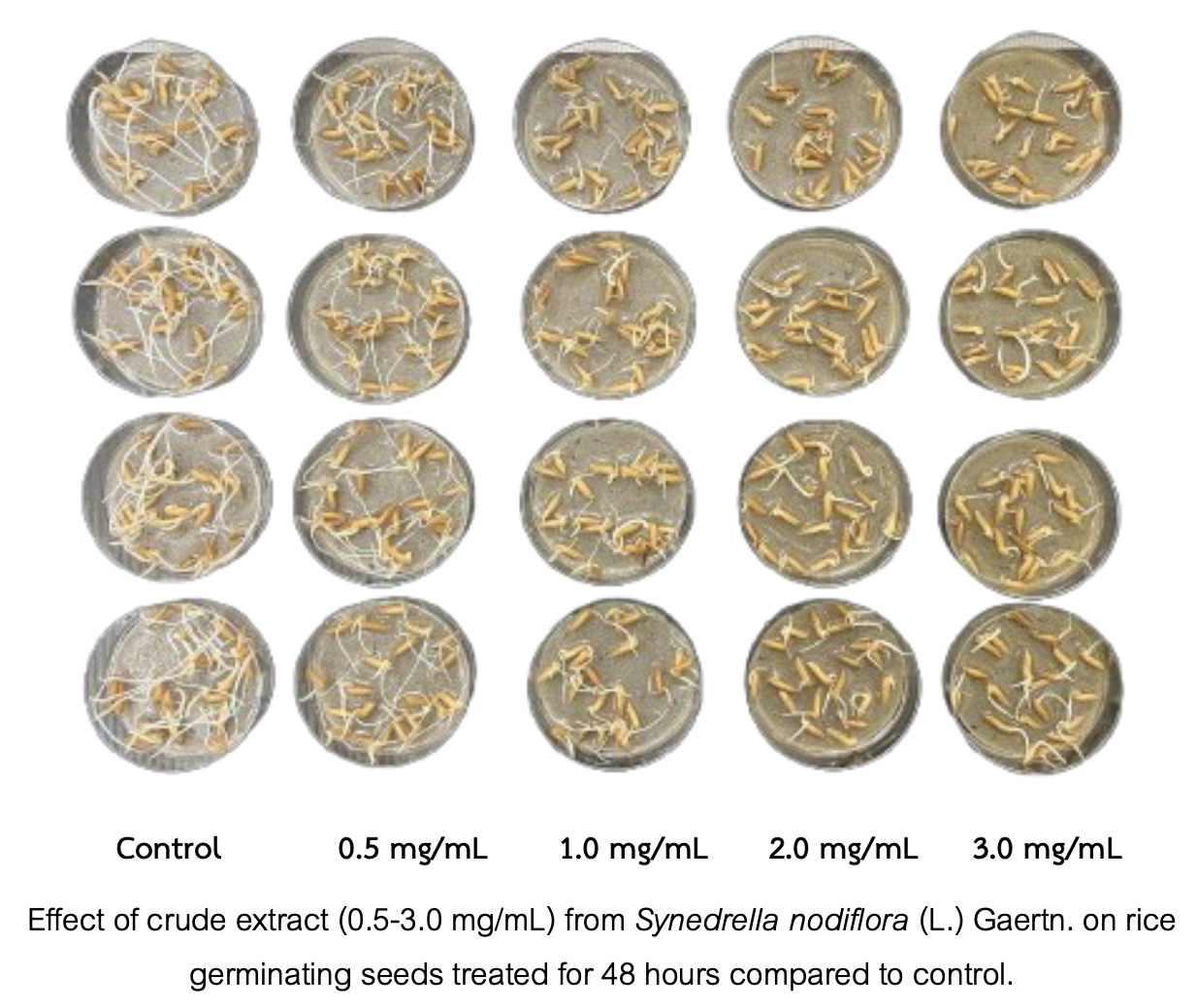
Methodology: This study comprised three experiments. In the first experiment, plant compounds were extracted from S. nodiflora leaves using 80% methanol. The mixture was macerated for 24 hours, filtered, and concentrated using a rotary evaporator to remove methanol, followed by freeze-drying to obtain the crude extract. This crude extract was subsequently prepared at concentrations of 0, 0.5, 1.0, 2.0, and 3.0 mg/mL. The bioassay was conducted on pre-germinated rice seeds with an initial radicle length of approximately 1 mm. The seeds were placed in glass Petri dishes, treated with 3 mL of the crude extract, and incubated in the dark at room temperature for 48 hours. Shoot and root lengths were then measured, and the data were converted into percentages relative to the control. The 50% inhibition concentration (IC50) was subsequently determined. In the second experiment, liquid-liquid partitioning was performed to fractionate the crude extract. The extract was dissolved in water and partitioned with ethyl acetate. The resulting ethyl acetate fraction was collected, evaporated to dryness, and used to the bioassay protocol as described in the first experiment. And the third experiment, the ethyl acetate fraction was further purified using column chromatography. The eluted fractions were evaporated to dryness and tested as the first experiment. The results were statistical tested by One-Way ANOVA and compared means by Tukey’s HSD at 95% confidence level.
Main Results: The results demonstrated that the crude extract at concentrations ranging from 0.5 to 3.0 mg/mL statistically significantly inhibited both shoot and root lengths of rice (p<0.05). Compared to the control group, shoot growth was suppressed by 13.75%–16.40%, while root growth was inhibited by 13.37%–93.86%. The IC50 for root growth was calculated and showed at 0.93 mg/mL, which was equivalent to 18 mg of leaf tissue per mL. Subsequently, the ethyl acetate fraction was prepared at a concentration equivalent to 18 mg of leaf tissue/mL and brought to bioassay on rice. The ethyl acetate fraction exhibited an inhibitory effect, with a higher potency against roots than shoots, which inhibited shoot and root growth by 40.11% and 79.33% relative to the control, respectively. Following purification via column chromatography, the isolated fractions (10 fractions) were evaporated to dryness and prepared to a concentration equivalent to 18 mg of leaf tissue/mL. The bioassay revealed that these fractions maintained statistically significant inhibitory activity on rice growth (p<0.05). Fraction 8 (at a concentration of 15.53x10⁻³ mg/mL) exhibited the highest inhibitory efficacy against both shoot and root growth.
Conclusions: In conclusion, extracts from S. nodiflora (L.) exhibited significant allelopathic potential to inhibit rice growth. When the extract was separated using the liquid fractionation method with ethyl acetate and further separated by column chromatography, it was found that the resulting extracts could inhibit the growth of rice shoots and roots. Fraction 8 may contain semipolar to nonpolar substances. Further research should involve fractionation to identify the active compounds to focus the initial potential of allelochemicals derived from S. nodiflora (L.) before study and develop into herbicides for sustainable agriculture.
References
Abenavoli, M. R., Lupini, A., & Sorgonà, A. (2001). Influence of coumarin on the net nitrate uptake in durum wheat. Plant Science, 161(4), 685-693.
Fangue-Yapseu, G. Y., Mouafo-Tchinda, R. A., Kenne, M. F., Onomo, P. E., & Djocgoue, P. F. (2021). Allelopathic effect of three wild plants (Azadirachta indica, Tithonia diversifolia and Thevetia peruviana) on Tomato (Lycopersicum esculentum Mill.) growth and stimulation of metabolites involved in plant resistance. American Journal of Plant Sciences, 12, 285-299.
Ghayal, N.A., Biware, M.V., & Dhumal, K.N. (2014). Effect of leachates of alien weeds on seed germination, seedling growth and physiology in Mungbean. International Journal of Agriculture and Bioscience, 3(4), 141-148.
Janusauskaite, D. (2023). The allelopathic activity of aqueous extracts of Helianthus annuus L., grown in boreal conditions, on germination, development, and physiological indices of Pisum sativum L. Plants, 12(9), 1920. https://doi.org/10.3390/plants12091920
John, J., & Sarada, S. (2012). Role of phenolics in allelopathic interactions. Allelopathy Journal, 29(2), 215-230.
Kato-Noguchi, H. (2024). Isolation and identification of allelochemicals and their activities and functions. Journal of Pesticide Science, 49(1), 1–14.
Kato-Noguchi, H., Hamada, Y., Kojima, M., Kumagai, S., Iwasaki, A., & Suenaga, K. (2023). Allelopathic substances of Osmanthus spp. for developing sustainable agriculture. Plants, 12(2), 376. https://doi.org/10.3390/plants12020376
Kijsutha, C., Diraksa, K., Aueangai, K., Chansuksri, P., & Phraprasert, P. (2025). Effects of Synedrella nodiflora (L.) Gaertn. leaves extracted by liquid-liquid partition on germination and growth of Pakchoi (Brassica chinensis Jusl var parachinensis (Bailey) Tsen & Lee). Burapha Science Journal, 30(3), 1019-1034. https://li05.tci-thaijo.org/index.php/buuscij/article/view/759
Kingthong, Y., & Phraprasert, P. (2023). Allelopathic effect from Synedrella nodiflora (L.) Gaertn. on seed-germinating physiology of pakchoi (Brassica chinensis Jusl var parachinensis (Bailey) Tsen & Lee). Burapha Science Journal, 28(3), 1653-1670. https://li05.tci-thaijo.org/index.php/buuscij/article/view/1125
Motamedi, M., Karimmojeni, H., & Sini, FG. (2016). Evaluation of allelopathic potential of safflower genotypes (Carthamus tinctorius L.). Journal of Plant Protection Research, 56(4), 364-371.
Nishida, N., Tamotsu, S., Sui, N., & Era, A. (2005). Allelopathic effects of volatile monoterpenoids produced by Salvia leucophylla. Journal of Chemical Ecology, 31(5), 1103–1116.
Pattanaik, B.N., & Mandalia, H.C. (2011). Ethyl acetate: Properties, production process and application. International Journal of Current Research and Review, 3(12), 23-40.
Siyar, S., Muhammad, Z., Hussain, F., Hussain, Z., Islam, S., & Majeed, A. (2018). Allelopathic effects of two Asteraceae weeds (Artemisia annua and Taraxicum officinalis) on germination of maize and wheat. PSM Biological Research, 3(2), 44-47.
Tesio, F., & Ferrero, A. (2010). Allelopathy, a chance for sustainable weed management. International Journal of Sustainable Development & World Ecology, 17(5), 377–389.
Tokgoz, A., Emsen, B., & Dogan, M. (2024). The efficacy of allelopathy of select lichens on antioxidant potentialand proliferation of Ceratophyllum demersum L. Plant Cell, Tissue and Organ Culture, 159, 26. https://doi.org/10.1007/s11240-024-02894-3
Downloads
Published
How to Cite
Issue
Section
License
Copyright (c) 2026 Faculty of Science, Burapha University

This work is licensed under a Creative Commons Attribution-NonCommercial-NoDerivatives 4.0 International License.
Burapha Science Journal is licensed under a Creative Commons Attribution-NonCommercial-NoDerivatives 4.0 International (CC BY-NC-ND 4.0) licence, unless otherwise stated. Please read our Policies page for more information