
Synergistic Antibacterial and Antibiofilm Activity of Glochidonol Isolated from 𝙂𝙡𝙤𝙘𝙝𝙞𝙙𝙞𝙤𝙣 𝙖𝙘𝙪𝙢𝙞𝙣𝙖𝙩𝙪𝙢 with Antibiotics against Opportunistic Bacteria
Keywords:
glochidonol, 𝘎𝘭𝘰𝘤𝘩𝘪𝘥𝘪𝘰𝘯 𝘢𝘤𝘶𝘮𝘪𝘯𝘢𝘵𝘶𝘮, synergistic effect, antibacterial activity, antibiofilm activityAbstract
Background and Objectives: Glochidonol, a bioactive compound isolated from Glochidion acuminatum, has been traditionally recognized for its analgesic, antipyretic, and diuretic properties. In recent years, scientific investigations have revealed that Glochidonol also possesses a broad spectrum of biological activities, including anti-inflammatory, antibacterial, antioxidant, and anticancer effects. These properties make it a promising candidate in the search for novel agents to combat emerging threats from drug-resistant microorganisms. Opportunistic bacterial pathogens such as Pseudomonas aeruginosa, Acinetobacter baumannii, Escherichia coli, Klebsiella pneumoniae, and Staphylococcus aureus are increasingly responsible for healthcare-associated infections, especially among immunocompromised individuals. Infections caused by this group of bacteria are often severe and tend to develop into bloodstream infections (septicemia), which may lead to serious complications or death. This condition reduces the effectiveness of antibiotics in the tetracycline group (such as Oxytetracycline) and the penicillin group (such as Ampicillin), rendering them less effective or ineffective.Opportunistic bacteria have developed various mechanisms of antibiotic resistance, such as producing drug-degrading enzymes, reducing membrane permeability, and most importantly, forming biofilms, complex structures composed of extracellular polymeric substances (EPS) secreted by the bacteria to encapsulate themselves and neighboring cells within the community. This protective matrix enables the bacteria to survive under unfavorable environmental conditions and adhere firmly to surfaces such as wounds or medical devices, making biofilm formation a key factor that accelerates the high incidence of antibiotic resistance among opportunistic bacteria. As conventional antibiotics such as Oxytetracycline) and Ampicillin) become less effective due to these resistance mechanisms, the development of new therapeutic strategies is urgently needed. One promising approach is the combination of natural bioactive compounds with existing antibiotics to restore or enhance antibacterial efficacy. Natural products like Glochidonol are of particular interest because they may disrupt biofilm formation, increase bacterial membrane permeability, or inhibit resistance-related enzymes, thereby potentiating the activity of conventional antibiotics. Therefore, the use of Glochidonol in combination with antibiotics may represent a new therapeutic alternative and constitutes the first study of this compound. Given this context, this study aims to evaluate the potential synergistic effects of Glochidonol, in combination with standard antibiotics, against opportunistic bacterial pathogens, with a particular focus on its ability to inhibit bacterial growth and biofilm formation. By investigating these combined effects, the research seeks to provide a scientific basis for utilizing Glochidonol as a complementary agent in antimicrobial therapy, offering a novel and sustainable strategy to combat drug-resistant infections and reduce the environmental impact of antibiotic-resistant bacteria.
Methodology : This study investigates the efficacy of Glochidonol in inhibiting the growth of opportunistic bacteria by determining the Minimal Inhibitory Concentration (MIC) using the broth microdilution assay. Glochidonol was prepared in various concentrations in Mueller Hinton Broth (MHB) and mixed with bacterial suspensions adjusted to 1 × 10⁸ CFU/mL. The samples were incubated at 37°C for 18–24 hours, and bacterial growth was conducted by measuring optical density at 600 nm (OD₆₀₀) to determine the MIC. To evaluate the synergistic antibacterial activity, the Fractional Inhibitory Concentration Index (FICI) was calculated using the checkerboard microdilution assay. Glochidonol was combined with antibiotics, and the mixtures were tested against bacterial suspensions at 1 × 10⁸ CFU/mL, following the same incubation protocol as the MIC assay. The FICI was calculated to determine potential synergistic effect between Glochidonol and antibiotics. The anti-biofilm activity of Glochidonol was determined using the Crystal Violet Assay. Bacterial cultures were incubated with Glochidonol or antibiotics for 24 hours, after which non-adherent cells were removed by washing with Phosphate Buffered Saline (PBS). Bacterial biofilms were stained with 0.1% crystal violet, fixed with 100%methanol, and the bacterial bound dye was solubilized using 33% glacial acetic acid. Biofilm biomass was quantified by measuring optical density at 600 nm.
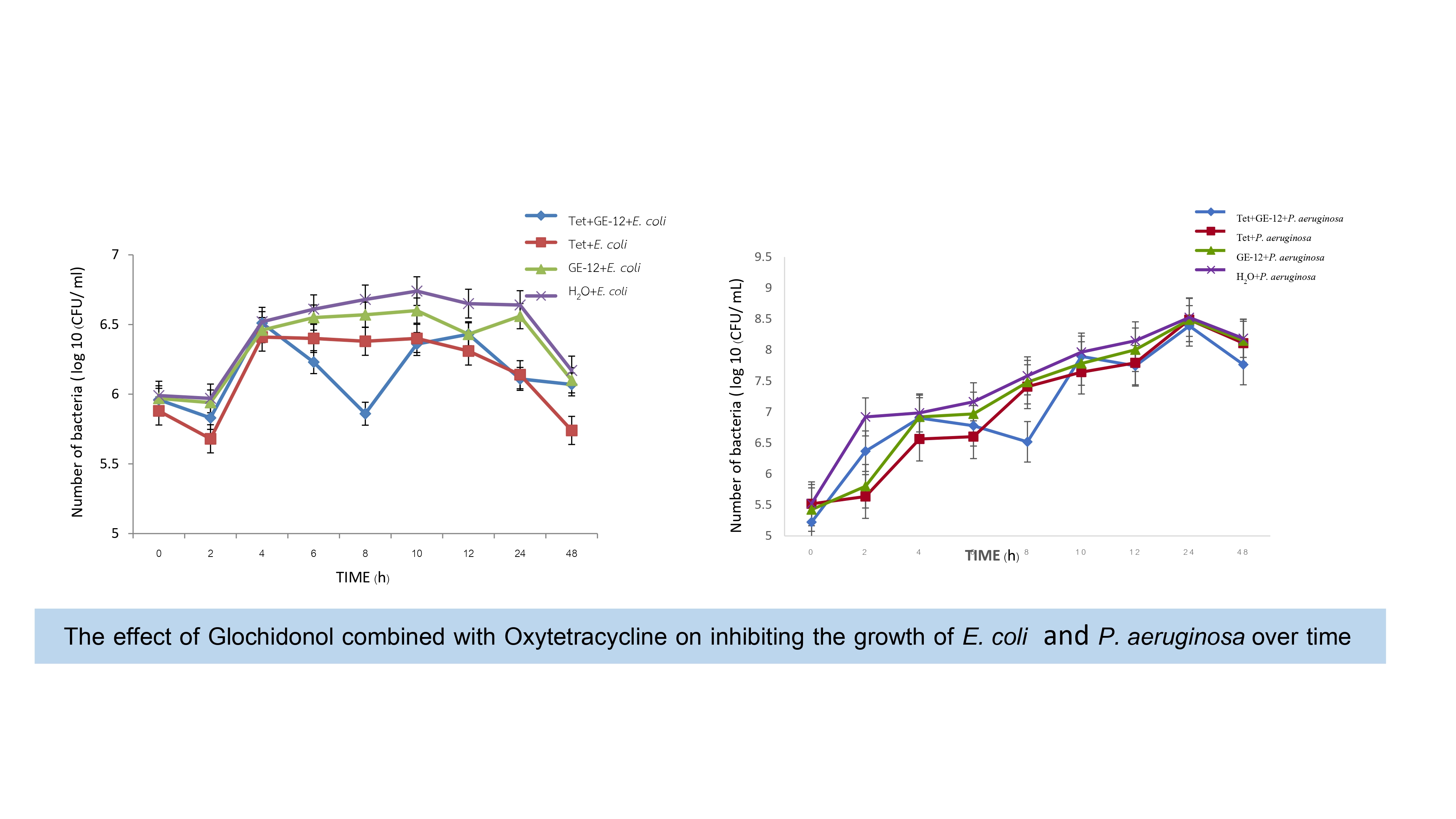
Main results : The purified compound Glochidonol (GE-12) was found to inhibit the growth of opportunistic bacteria, including both Gram-positive and Gram-negative bacteria. GE-12 exhibited its strongest antibacterial activity against Gram-negative bacteria, particularly against A. baumannii and K. pneumoniae, with a MIC of 128 µM. When compared with conventional antibiotics, GE-12 demonstrated comparable efficacy to Ampicillin and Oxytetracycline. Moreover, GE-12 showed the best synergistic effect with Oxytetracycline against Escherichia coli, with a FICI value of 0.56. In contrast, it showed antagonistic effect against Pseudomonas aeruginosa (FICI = 32) and had no synergistic effect against A. baumannii. The time-kill assay revealed that GE-12 most effectively inhibited E. coli growth at 8 hours when used at 16 µM (1/64 MIC) in combination with Oxytetracycline at 256 µM (1/8 MIC). For P. aeruginosa, the best inhibitory effect was observed when GE-12 at 16 µM (1/32 MIC) was combined with Oxytetracycline at 2048 µM (1× MIC). Additionally, GE-12 at a concentration of 2048 µM was most effective in inhibiting biofilm formation of A. baumannii, E. coli, and P. aeruginosa over a 2–24hour period, with inhibition rates ranging from 25% to 68%.
Conclusions : Glochidonol isolated from G. acuminatum demonstrated stronger inhibitory activity against Gram-negative bacteria compared to Gram-positive bacteria. It also exhibited synergistic effects in inhibiting bacterial growth and biofilm formation in both drug-resistant and non-resistant strains, particularly E. coli and P. aeruginosa.
References
Alrashidi, A., Jafar, M., Higgins, N., Mulligan, C., Varricchio, C., Moseley, R., Celiksoy, V., Houston, D. M. J., & Heard, C. M. (2021). A time-kill assay study on the synergistic bactericidal activity of pomegranate rind extract and Zn (II) against methicillin-resistant Staphylococcus aureus (MRSA), Staphylococcus epidermidis, Escherichia coli, and Pseudomonas aeruginosa. Biomolecules, 11(12), 1889. https://doi.org/10.3390/biom11121889
Bai, J., Aswathanarayan, J. B., & Rai, R. V. (2018). Inhibition of biofilm formation and quorum sensing mediated phenotypes by berberine in Pseudomonas aeruginosa and Salmonella typhimurium. RSC Advances, 8(62), 36133–36141. https://doi.org/10.1039/C8RA06413J
Cheesman, M. J., Ilanko, A., Blonk, B., & Cock, I. E. (2017). Developing new antimicrobial therapies: Are synergistic combinations of plant extracts/compounds with conventional antibiotics the solution? Pharmacognosy Reviews, 11(22), 57–72.
Chung, P. Y., Navaratnam, P., & Chung, L. Y. (2011). Synergistic antimicrobial activity between pentacyclic triterpenoids and antibiotics against Staphylococcus aureus strains. Annals of Clinical Microbiology and Antimicrobials, 10(25), 1–6.
Clinical and Laboratory Standards Institute (CLSI). (2024). Performance Standards for Antimicrobial Susceptibility Testing; 34th Ed. CLSI Document M100-Ed34. Clinical and Laboratory Standards Institute.
El-Wafa, W. M. A., Ahmed, R. H., & Ramadan, M. A. H. (2020). Synergistic effects of pomegranate and rosemary extracts in combination with antibiotics against antibiotic resistance and biofilm formation of Pseudomonas aeruginosa. Brazilian Journal of Microbiology, 51(3), 1079–1092.
Guzzo, F., Scognamiglio, M., Fiorentino, A., Buommino, E., & D’Abrosca, B. (2020). Plant-derived natural products against Pseudomonas aeruginosa and Staphylococcus aureus: Antibiofilm activity and molecular mechanisms. Molecules, 25(21), 5024. https://doi.org/10.3390/molecules25215024
Jesus, J. A., Lago, J. H. G., Laurenti, M. D., Yamamoto, E. S., & Passero, L. F. D. (2015). Antibacterial activity of ursolic acid and oleanolic acid: An update. Evidence-Based Complementary and Alternative Medicine, 2015, 620472. https://doi.org/10.1155/2015/620472
Khalequeuzzaman, M., Hasan, S. A., Haque, M., Parul, R., & Alam, R. M. (2023). Evaluation of antioxidant and anti-inflammatory activity of ethanolic extract of Glochidion acuminatum leaves. Asian Journal of Pharmaceutical Research, 13(2), 65–70. https://doi.org/10.52711/2231-5691.2023.00017
Khwaza, V., & Aderibigbe, B. A. (2024). Potential pharmacological properties of triterpene derivatives of ursolic acid. Molecules, 29(16), 3884. https://doi.org/10.3390/molecules29163884
Kim, G. S., Park, C. R., Kim, J. E., Kim, H. K., & Kim, B. S. (2022). Anti-biofilm effects of Torilis japonica ethanol extracts against Staphylococcus aureus. Journal of Microbiology and Biotechnology, 32(2), 220–227.
Kongcharoensuntorn, W., & Somnuk, W. (2021). Antibacterial activity of Glochidiol from Glochidion eriocarpum enhanced tetracycline against opportunistic bacteria. Burapha Science Journal, 26(3), 1–10. (in Thai)
Kuete, V., Ngameni, B., Tangmouo, J. G., Bolla, J. M., Alibert-Franco, S., Ngadjui, B. T., & Pagès, J. M. (2010). Efflux pumps are involved in the defense of Gram-negative bacteria against the natural products isobavachalcone and diospyrone. Antimicrobial Agents and Chemotherapy, 54(5), 1749–1752. https://doi.org/10.1128/AAC.01533-09
Kyriakidis, I., Vasileiou, E., Pana, Z. D., & Tragiannidis, A. (2021). Acinetobacter baumannii antibiotic resistance mechanisms. Pathogens, 10(3), 373. https://doi.org/10.3390/pathogens10030373
Linh, N. N., Hop, N. Q., Nhung, P. T. T., Dao, P. T. T., Manh, P. T. B., Pham, Y. V., & Son, N. T. (2024). Glochidion species: A review on phytochemistry and pharmacology. Journal of Experimental Pharmacology. https://doi.org/10.1177/1934578X241276962
Lu, L., Hu, W., Tian, Z., Yuan, D., Yi, G., Zhou, Y.l. (2019). Developing natural products as potential anti-biofilm agents. Chinese Medicine, 14, 11. https://doi.org/10.1186/s13020-019-0232-2
Nhiem, N. X., Thu, V. K., Kiem, P.V., Minh, C. V., Tai, B. H., Quang, T. H., Cuong, N. X., Yen, P. H., Boo, H. J., Kang, J. I., Kang, H. K., & Kim, Y. H. (2012). Cytotoxic oleane-type triterpene saponins from Glochidion eriocarpum. Archives of Pharmacal Research volume 35(1), 19-26.
Puapairoj, P., Naengchomnong, W., Kijjoa, A., Pinto, M., Nascimento, M. S., Silva, A. M., & Herz, W. (2005). Cytotoxic activity of lupane-type triterpenes from Glochidion sphaerogynum and Glochidion eriocarpum, two of which induce apoptosis. Planta Medica, 71, 208–213.
Ramli, S., Radu, S., Shaari, K., & Rukayadi, Y. (2017). Antibacterial activity of ethanolic extract of Syzygium polyanthum L. (Salam) leaves against foodborne pathogens and application as food sanitizer. BioMed Research International. https://doi.org/10.1155/2017/9024246
Smitinand, T., Larsen, K. & Santisuk, T. (2007). Flora of Thailand. Vol. 8 part 2. Bangkok: Forest Herbarium, Royal Forest Department.
Song, T., Duperthuy, M., & Wai, S. N. (2016). Sub-optimal treatment of bacterial biofilms. Antibiotics, 5(2), 23. https://doi.org/10.3390/antibiotics5020023
Song, Y. J., Yu, H. H., Kim, Y. J., Lee, N. K., & Paik, H. D. (2019). Anti-biofilm activity of grapefruit seed extract against Staphylococcus aureus and Escherichia coli. Journal of Microbiology and Biotechnology, 29(8), 1177–1183.
Teixeira, E. H., Andrade, A. L., Pereira, R., Farias, L. P., Monteiro, G. S., & Marinho, M. M. (2023). Antimicrobial, antibiofilm activities and synergic effect of triterpene 3β,6β,16β-trihydroxyilup-20(29)-ene isolated from Combretum leprosum leaves against Staphylococcus strains. Current Microbiology, 80(5), 176. https://doi.org/10.1007/s00284-023-03284-2
Thang, T. D., Kuo, P. C., Yu, C. S., Shen, Y. C., Hoa, L. T. M., Thanh, T. V., Kuo, Y. H., Yang, M. L., & Wu, T. S. (2011). Chemical constituents of the leaves of Glochidion obliquum and their bioactivity. Archives of Pharmacal Research, 34(3), 383–389. https://doi.org/10.1007/s12272-011-0305-y
Verderosa, A. D., Totsika, M., & Fairfull-Smith, K. E. (2019). Bacterial biofilm eradication agents: A current review. Frontiers in Chemistry, 7, 824.
Welzen, P.C., & Chayamarit, K. (2007). Flora of Thailand. Vol. 8 part 2. Bangkok : National park wildlife and plant conservation department.
Yang, Y. S., Wei, W., Hu, X. X., Tang, S., Pang, J., You, X. F., Fan, T. Y., Wang, Y. X., & Song, D. Q. (2018). Evolution and antibacterial evaluation of 8-hydroxy-cycloberberine derivatives as a novel family of antibacterial agents against MRSA. Molecules, 24(5), 984.
Zhang, X., Chen, J., & Gao, K. (2012). Chemical constituents from Glochidion wrightii Benth. Biochemical Systematics and Ecology 45, 7-11.
Downloads
Published
How to Cite
Issue
Section
License
Copyright (c) 2026 Faculty of Science, Burapha University

This work is licensed under a Creative Commons Attribution-NonCommercial-NoDerivatives 4.0 International License.
Burapha Science Journal is licensed under a Creative Commons Attribution-NonCommercial-NoDerivatives 4.0 International (CC BY-NC-ND 4.0) licence, unless otherwise stated. Please read our Policies page for more information