
Effect of Supplementation Amino Acids in Common Lowland Frog; 𝙍𝙖𝙣𝙖 𝙧𝙪𝙜𝙪𝙡𝙤𝙨𝙖 (Wiegmann, 1935) Diets on Growth Performance and Survival Rate
Keywords:
amino acid , 𝘙𝘢𝘯𝘢 𝘳𝘶𝘨𝘶𝘭𝘰𝘴𝘢, growth rate , survival rateAbstract
Background and Objectives: This study aimed to investigate the optimal dietary amino acid supplementation level on weight gain and survival rate of the common lowland frog (Raguna rugulosa). The common lowland frog is an economically important aquatic species that is widely favored by consumers and has a continuous market demand throughout the year. Moreover, it has considerable potential for international trade in both live and frozen forms, resulting in increasing interest in common lowland frog culture among farmers. However, frog farming often encounters limitations related to feed efficiency, leading to relatively high feed conversion ratios and increased production costs. Therefore, the development of appropriate nutritional strategies to enhance growth performance is of particular importance. Dietary amino acid supplementation represents a potential approach, as amino acids are the basic components of proteins and can be absorbed and utilized by the organism more efficiently than intact proteins. Under normal conditions, dietary proteins must be digested into amino acids before absorption into the bloodstream, whereas direct amino acid supplementation allows for more rapid utilization by the body. This may promote improved growth performance and enable frogs to reach marketable size within a shorter rearing period compared with conventional feeding practices.
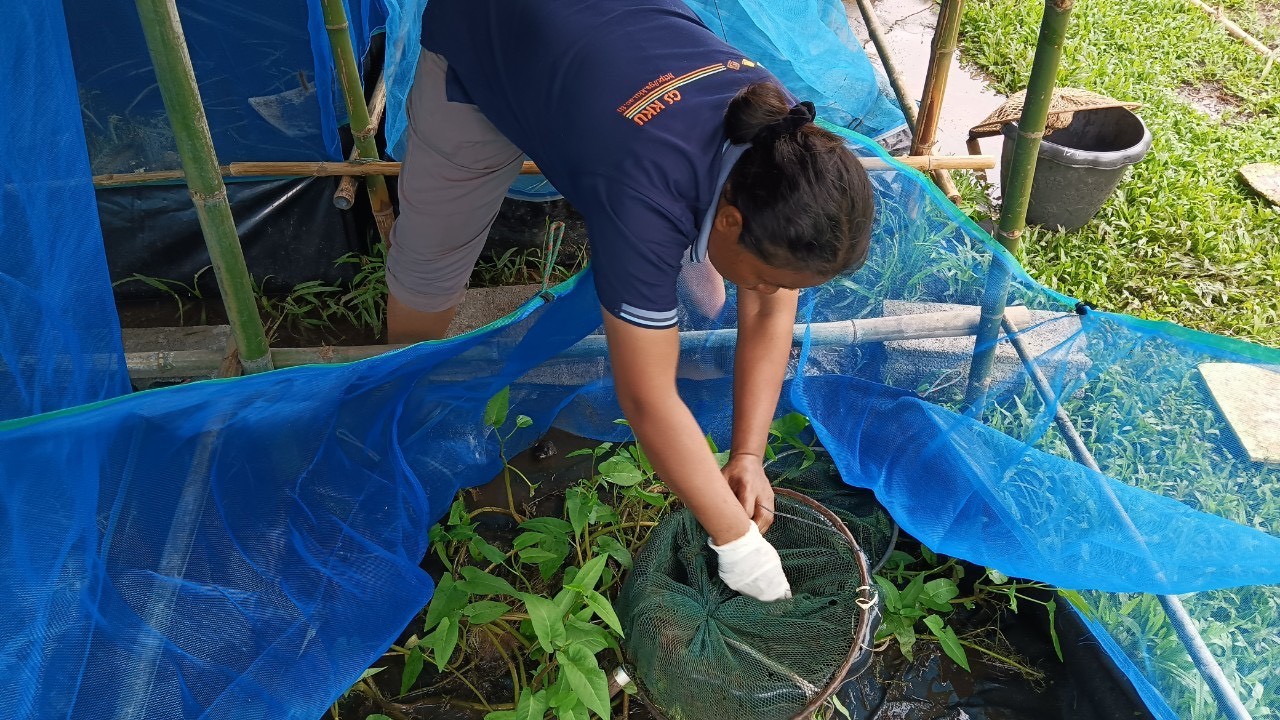
Methodology : The experiment was conducted using a Completely Randomized Design (CRD) with six dietary treatments, each with three replicates. The treatments consisted of different levels of concentrated amino acid supplementation in a commercial pelleted diet at 0 (control), 0.125, 0.25, 0.50, 0.75, and 1.00 mL per Kg of feed. The amino acid concentrate comprised 19 amino acids: arginine, isoleucine, leucine, histidine, threonine, methionine, tryptophan, phenylalanine, valine, lysine, glutamine, aspartate, glycine, cysteine, tyrosine, proline, alanine, serine, and hydroxyproline. Common lowland frog juveniles 45 days old with an initial body weight of approximately 2–3 g, were used in the study. The frogs were randomly stocked into land-based net cages measuring 1 × 1 × 0.8 m at a density of 20 individuals per cage, resulting in a total of 240 frogs. Initial body weight was recorded for all individuals (100%) in each experimental unit and replicate. The feeding trial lasted for 90 days and was divided into 3 phases. During days 1–20, frogs were fed a high-grade commercial diet containing 42% crude protein. From days 21–40, a small pellet diet containing 35% crude protein was provided, and from days 41–90, a medium pellet diet containing 30% crude protein was used. The diets were supplemented with liquid concentrated amino acids according to the respective treatments. Frogs were fed at a rate of 10% of body weight per day during the first 20 days and 5% of body weight per day thereafter. Feeding was conducted twice daily, in the morning and evening. Growth performance and survival rate were evaluated by randomly sampling and weighing 10 frogs (50%) from each experimental unit and replicate at 10 day intervals throughout the 90 day experimental period.
Main Results : At the beginning of the experiment, common lowland frogs had an average initial body weight of 2.46 ± 0.06 g. Throughout the experimental period, frogs fed diets supplemented with amino acids exhibited a continuous increase in body weight. At the end of the experiment, the data were subjected to statistical analysis using analysis of variance (ANOVA). The results indicated no significant differences (P > 0.05) in weight growth performance or survival rate among frogs fed diets supplemented with different levels of amino acids. However, frogs receiving amino acid supplementation at levels of 0.125, 0.25, 0.50, 0.75, and 1.00 mL per kg of feed tended to show higher growth performance and survival rates compared with frogs fed the control diet without amino acid supplementation. Notably, frogs fed diets supplemented with amino acids at 0.25 mL per kg of feed exhibited the best performance in terms of final body weight, average weight gain, average daily weight gain, and survival rate, with values of 101.27 ± 3.03 g, 1.13 ± 0.03 g per day and 98.33 ± 2.89 %, respectively. This was followed by supplementation levels of 0.50, 0.75, 1.00, 0.125, and 0 mL per kg of feed (control).
Conclusions : The results of this study indicated that amino acid supplementation in the diets of common lowland frogs had no significant effects on growth performance, feed conversion ratio (FCR), or survival rate. However, frogs fed amino acid supplemented diets tended to exhibit better growth performance and survival compared with those fed the unsupplemented control diet. In particular, the supplementation level of 0.25 mL per kg of feed showed superior performance compared with all other treatments. In contrast, higher levels of amino acid supplementation (0.75 and 1.00 mL per kg of feed) tended to result in reduced growth performance and survival rates. Therefore, amino acid supplementation in aquaculture feeds should be carefully evaluated to determine appropriate and optimal inclusion levels that meet the nutritional requirements of the cultured species without adverse effects.
References
Bercovici, D., & Fuller, M. F. (1995). Industrial amino acids in nonruminant animal nutrition. Biotechnology in animal feeds and animal feeding, 93-113.
Chuphal, N., Malik, M. A., Kishore, P. S., & Mohanta, K. N. (2025). Amino acids as functional nutrients in stress mitigation of aquatic species: mechanisms and applications in aquaculture. Blue Biotechnology, 2(1), 20.
Chuapoehuk, W. (1997). Aquatic animal Nutrition and Feeding. 2 nd. Bangkok: Kasetsart University Publisher. 255 p. (in Thai)
Department of fisheries. (2022). Fisheries Statistics of Thailand 2021. Fishery Statistics Group Fisheries Development Policy and Planning Division, No. 14/2022. (in Thai)
Duangjinda, M. (2001). Using SAS Programs to Analyze Animal Research. 2 nd. Khon Kean: Klungnanawittaya Publisher. 324 p. (in Thai).
Ferrie, G. M., Alford, V. C., Atkinson, J., Baitchman, E., Barber, D., Blaner, W. S., & Valdes, E. V. (2014).Nutrition and health in amphibian husbandry. Zoo biology, 33(6), 485-501.
Hertrampf, J. W., & Piedad-Pascual, F. (2012). Handbook on ingredients for aquaculture feeds. Springer Science & Business Media.
Khoklang, A. (2023). Supplementation of Free Amino Acids Mix in Diet for Asian seabass (Lates calcarifer, Bloch) Larvae. A Thesis Submitted in Partial Fulfillment of Requirements for Master of Science (Agriculture). (in Thai)
Mansano, C. F. M., Macente, B. I., Nascimento, T. M. T., Pereira, M. M., da Silva, E. P., & De Stéfani, M. V. (2017). Determination of digestible lysine and estimation of essential amino acid requirements for bullfrogs. Aquaculture, 467, 89-93.
Srimontree, S., Jintasathaporn, O., Tabthipwon, P., & Thaitungchin, C. (2011). Supplemental Amino acids and Organic acids on growth Performance of White shrimp (Litopenaeus vannamei). In Proceedings of the 49th Kasetsart University Annual Conference 1 – 4 February 2001. (pp. 357-364). (in Thai).
Tantikitti, C., Sermwatanakul, A., Wimol Jantrarotai, W., & Supamattaya, K. (2002). Quantitative Amino Acid Requirements of Yellow Mystus (Mystus nemurus Cuv. & Val.). Research Report. Department of Aquatic Science Faculty of Natural Resources, Prince of Songkla University. 141 p. (in Thai)
Xing, S., Liang, X., Zhang, X., Oliva‐Teles, A., Peres, H., Li, M., & Xue, M. (2024). Essential amino acid requirements of fish and crustaceans, a meta‐analysis. Reviews in Aquaculture, 16(3), 1069-1086.
Zhang, Y., Lu, R., Qin, C., & Nie, G. (2020). Precision nutritional regulation and aquaculture. Aquaculture reports, 18, 100496.
Zhang, M., Wang, S., Sun, Z., Jiang, H., Qian, Y., Wang, R., & Li, M. (2022). The effects of acute and chronic ammonia exposure on growth, survival, and free amino acid abundance in juvenile Japanese sea perch Lateolabrax japonicus. Aquaculture, 560, 738512.
Downloads
Published
How to Cite
Issue
Section
License
Copyright (c) 2026 Faculty of Science, Burapha University

This work is licensed under a Creative Commons Attribution-NonCommercial-NoDerivatives 4.0 International License.
Burapha Science Journal is licensed under a Creative Commons Attribution-NonCommercial-NoDerivatives 4.0 International (CC BY-NC-ND 4.0) licence, unless otherwise stated. Please read our Policies page for more information