
Investigation of Land Use and Land Cover Change and Urban Heat Island Phenomenon in Nakhon Ratchasima Province
Keywords:
Land Surface Temperature (LST) , Urban Heat Island (UHI) , Welch’s ANOVA , land use and land cover change , Nakhon Ratchasima ProvinceAbstract
Background and Objectives: Urbanization constitutes a significant physical and sociodemographic transformation of the 21st century, exerting considerable influence on global ecosystems and local microclimates. Human-induced alterations in the previously vegetated and permeable soil structure of natural landscapes, along with their transformation into concrete, asphalt, and decorative architectural developments, significantly affect the Surface Energy Budget (SEB). These alterations generate an artificial environment that disrupts the natural equilibrium of the Latent Heat Flux. Latent Heat Flux decreases exponentially because of insufficient evapotranspiration, concurrently leading to an increase in the storage and re-release of Sensible Heat Flux. The Urban Heat Island (UHI) Effect refers to the phenomenon where urban areas experience higher temperatures than their rural surroundings due to human activities and alterations in land cover. The Urban Heat Island (UHI) Effect refers to a temperature phenomenon where urbanized areas exhibit markedly elevated atmospheric and surface temperatures compared to nearby rural regions. The Urban Heat Island (UHI) Effect refers to a temperature phenomenon in which urbanized areas exhibit markedly elevated atmospheric and surface temperatures compared to nearby rural regions. The UHI Effect has significant implications, including increased energy demands for air conditioning, deterioration of air quality due to heightened ground-level ozone production, and substantial risks to human health and urban living conditions. Nakhon Ratchasima Province is strategically located as the Gateway of Isan, serving as the biggest economic, industrial, and transportation center of Northeastern Thailand. The province has undergone significant structural urbanization in the last two decades. The expansion has been driven by major infrastructure assets and an increase of industrial areas. The city is experiencing thermal challenges due to its expansion. The previous study on the UHI phenomenon in this domain has been mainly descriptive. Literature often exhibits insufficient statistical validation to quantify temperature variations among various Land Use and Land Cover (LULC) types and is frequently hindered by methodological limitations concerning satellite image data calibration. Addressing these significant studies problems. This study aims to: (1) analyze the spatiotemporal changes in land use and land cover (LULC) from 2006 to 2021 and (2) assess the impact on structural changes in urban heat island (UHI) intensity and dynamics, by using high-quality radiometric data and robust statistical methods to verify the accuracy and reliability of the results.
Methodology: This study employed a Hybrid Classification method for the analysis of Land Use and Land Cover (LULC) for optimal accuracy of data and consistency. The 2006 LULC database published by the Land Development Department (LDD) was used as the baseline for this study. In 2021, LULC classification occurred by using multispectral imagery from the Landsat 8 Operational Land Imager (OLI) sensor that was acquired during the dry season in February to avoid cloud influence and variations in the season. The classification process used the Maximum Likelihood Classification (MLC) algorithm, that is a parametric supervised learning method based on the assumption of a normal distribution of image pixels within each training class. The classification accuracy was assessed through Stratified Random Sampling involving 205 reference points, results in an Overall Accuracy of 95% and a Kappa Coefficient of 0.90, which refers to an excellent level of agreement between the LULC classified map and in-situ data. The temperature evaluation focused on capturing Land Surface Temperature (LST) and identified data quality through the selection of USGS Collection 2 Level-2 Science Products (L2SP). The measurements of temperatures have been acquired from Landsat 5 Thematic Mapper (TM) for February 2007 and from Landsat 8 Thermal Infrared Sensor (TIRS) for February 2021. A selection was taken to apply data from the same temporal season (dry/cool season), and the selection of 2007 LST as a baseline estimate effectively reduced discrepancies associated with seasonal variability and atmospheric absorption. This study uses advanced statistical methods to evaluate the relationship between LST and various LULC types, expanding higher than simple descriptive statistics. Welch’s One-way ANOVA was used to improve its resistance against violations of homogeneity of variance assumptions, which are often present in environmental datasets. Post-hoc pairwise comparisons were performed utilizing the Games-Howell method. The spatial impact of heat island variation has been evaluated by using the Urban Heat Island Ratio Index (URI) and the Temperature Grade Change Index (TGCI) to show and quantify heat island expansion.
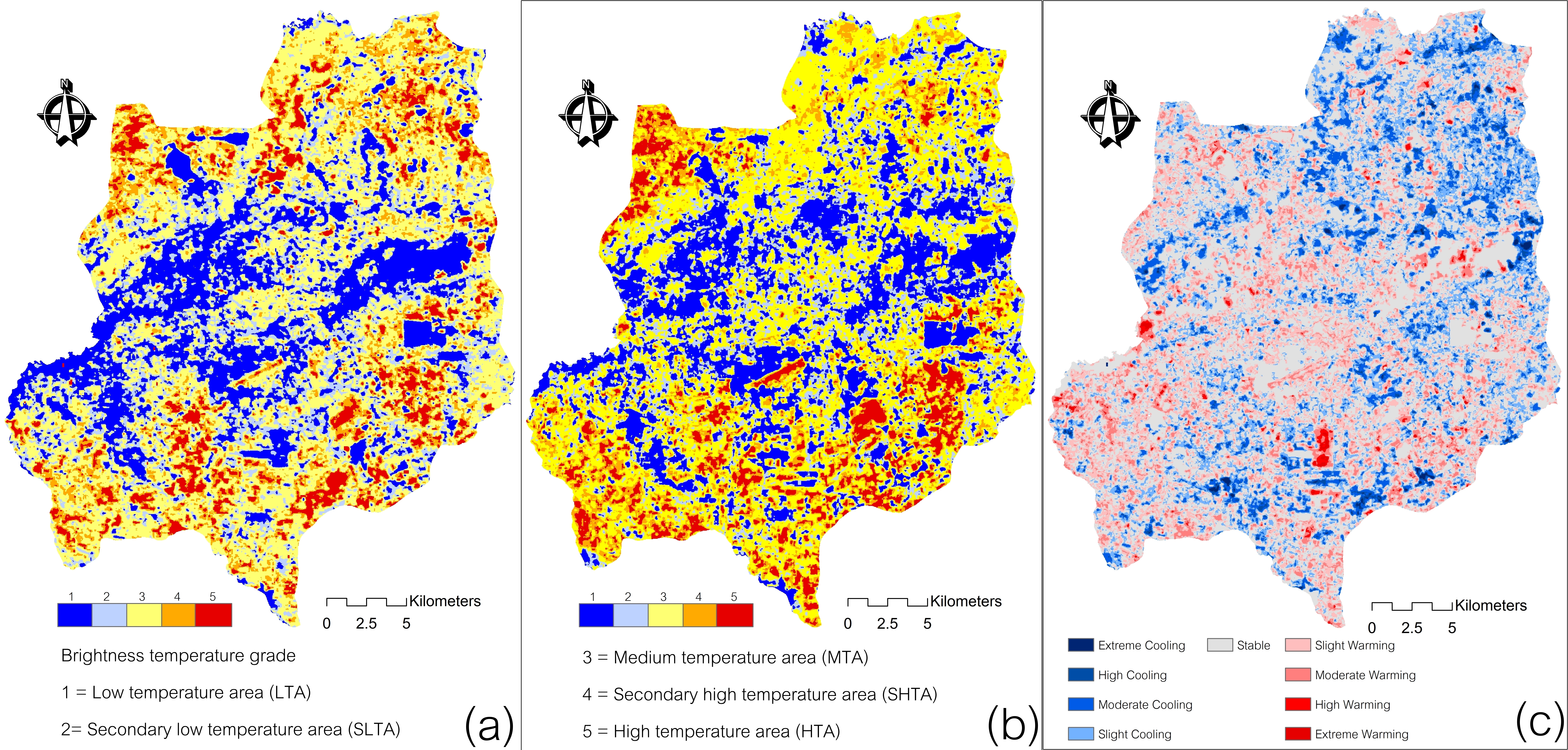
Main Results: The Transition Matrix analysis showed that the city's urban morphology changed a lot in terms of structure throughout the 15 years of research. Urban and built-up areas grew by a net of 73.66 square kilometers, which is a huge growth rate of 34.46% compared to the baseline. This urban and built-up area expansion primarily occurred on agricultural land (55.32 sq. km.) while other of LULC (23.35 sq. km.). Additionally, the analysis found that forest land decreased by 49.83%, which shows how significantly people are placing stress on natural resources and their buffers. Statistical analysis of the 2021 LST data found important proof of the UHI effect. The average surface temperature in urban and built-up areas was 28.4°C, which was significantly greater than the average surface temperature in forests land (25.40°C), with a statistical significance of p < .001. The average temperature difference of about 2.99°C shows how urbanization impacts the temperature. The result is distinct from the baseline LULC data from 2007, that showed a lack of statistical significance between urban and built-up areas and forest area temperatures. This indicates that the city has changed from a temperature balanced condition to a distinct island. In 2021, the mean temperature in the area decreased into slightly because of the La Niña phenomenon, which decreases the region. However, the location inside thermal structure became more severe. The URI analysis showed that the number of regions classified as "High Temperature Grade" increased from 7.30% to 7.39% of the whole area studied. This indicates that the increase due to urbanization is strong enough to cause local cooling patterns in the surrounding environment. The Linear Regression study also showed a strong positive relation between the Normalized Difference Built-up Index (NDBI) and LST. The coefficient of slope increasing higher in 2021 shows that the current urban surface elements in Nakhon Ratchasima are becoming increasingly prone to heat accumulation and retention.
Conclusions : This study shows that the fast urbanization of Nakhon Ratchasima during the past fifteen years has greatly exacerbated the UHI phenomena. The city has transitioned from thermal equilibrium to a fully developed heat island, mostly due to alterations in urban morphology rather than regional climatic influences. The results have serious effects on urban planning and policy. Statistical evidence indicates that there is a major negative relationship between LST and NDVI and MNDWI. Therefore, city planners require that they quickly add "Blue-Green Infrastructure" to the city's overall strategy. Several actions that should be implemented are to protect the original forest areas, build green spaces in cities, and restore water bodies. These actions have been shown to be the most effective approaches to decrease UHI intensity, increase Nakhon Ratchasima more comfortable in hot weather, as well as making it more resilient to climate change as the future urban expansion.
References
Anselin, L., Syabri, I., & Kho, Y. (2006). GeoDa: An introduction to spatial data analysis. Geographical Analysis, 38(1), 5–22. https://doi.org/10.1111/j.0016-7363.2005.00671.x
Alberti, M., Marzluff, J. M., Shulenberger, E., Bradley, G., Ryan, C., & Zumbrunnen, C. (2008). Integrating humans into ecology: Opportunities and challenges for studying urban ecosystems. Urban Ecology: An International Perspective on the Interaction Between Humans and Nature, 53(12), 143–158.
Andersson, E. (2006). Urban landscapes and sustainable cities. Ecology and Society, 11(1). https://doi.org/10.5751/ES-01639-110134
Baró, F., Haase, D., Gómez‐Baggethun, E., & Frantzeskaki, N. (2015). Mismatches between ecosystem services supply and demand in urban areas: A quantitative assessment in five European cities. Ecological Indicators, 55, 146-158. https://doi.org/10.1016/j.ecolind.2015.03.013.
Basara, J. B., Basara, H. G., Illston, B. G., & Crawford, K. C. (2010). The impact of the Urban Heat Island during an intense heat wave in Oklahoma City. Advances in Meteorology, 2010, 1–10. https://doi.org/10.1155/2010/230365
Chotchaiwong, P., & Wijitkosum, S. (2019). Relationship between land surface temperature and land use in Nakhon Ratchasima City, Thailand. Engineering Journal, 23(4), 1–14. https://doi.org/10.4186/ej.2019.23.4.1
Cook, M., Schott, J. R., Mandel, J., & Raqueno, N. (2014). Development of an operational calibration methodology for the Landsat thermal data archive and initial testing of the atmospheric compensation component of a Land Surface Temperature Product. Remote Sensing, 6(11), 11244-11266.
Cui, L., & Shi, J. (2012). Urbanization and its environmental effects in Shanghai, China. Urban Climate, 2, 1–15. https://doi.org/10.1016/j.uclim.2012.10.008
Curran, P. J. (1985). Principles of Remote Sensing. Longman, London.
Dan, S., Xu, H., Xue, W., He, J., & Dan, B. (2010). Comparison and analysis of research methods for urban heat island effect based on Landsat TM6. 2010 2nd IITA International Conference on Geoscience and Remote Sensing (IITA-GRS 2010), 1, 161–164. https://doi.org/10.1109/IITA-GRS.2010.5602992
Deng, X., Zhao, C., & Yan, H. (2013). Systematic modeling of impacts of land use and land cover changes on regional climate: A review. Advances in Meteorology, 2013, 1–11. https://doi.org/10.1155/2013/317678
Deng, Y., Wang, S., Bai, X., Tian, Y., Wu, L., Xiao, J., Chen, F., & Qian, Q. (2018). Relationship among land surface temperature and LUCC, NDVI in typical karst area. Scientific Reports, 8(1), 641. https://doi.org/10.1038/s41598-017-19088-x
Fitzpatrick-Lins, K. (1981). Comparison of sampling procedures and data analysis for a land-use and land-cover map. Photogrammetric Engineering and Remote Sensing, 47(3), 343-351.
Guechi, I., Gherraz, H., & Alkama, D. (2021). Correlation analysis between biophysical indices and Land Surface Temperature using remote sensing and GIS in Guelma city (Algeria). Bulletin de la Société Royale des Sciences de Liège. https://doi.org/10.25518/0037-9565.10457.
Guha, S., Govil, H., Gill, N., & Dey, A. (2020). Analytical study on the relationship between land surface temperature and land use/land cover indices. Annals of GIS, 26(2), 201–216. https://doi.org/10.1080/19475683.2020.1754291
Kalnay, E., & Cai, M. (2003). Impact of urbanization and land-use change on climate. Nature, 423(6939), 528–531. https://doi.org/10.1038/nature01675
Khamchiangta, D., & Dhakal, S. (2020). Time series analysis of land use and land cover changes related to urban heat island intensity: Case of Bangkok Metropolitan Area, Thailand. Journal of Urban Management, 9(4), 383-395.
Kometa, S. S., & Akoh, N. R. (2012). The hydro-geomorphological implications of urbanisation in Bamenda, Cameroon. Journal of Sustainable Development, 5(6). https://doi.org/10.5539/jsd.v5n6p64
Landis, J. R., & Koch, G. G. (1977). The measurement of observer agreement for categorical data. Biometrics, 33(1), 159–174. https://doi.org/10.2307/2529310
Lin, Y. P., Lin, Y. Bin, Wang, Y. T., & Hong, N. M. (2008). Monitoring and predicting land-use changes and the hydrology of the urbanized Paochiao watershed in Taiwan using remote sensing data, urban growth models and a hydrological model. Sensors, 8(2), 658–680. https://doi.org/10.3390/s8020658
Lundholm, J. T., & Richardson, P. J. (2010). Habitat analogues for reconciliation ecology in urban and industrial environments. Journal of Applied Ecology, 47(5), 966–975. https://doi.org/10.1111/j.1365-2664.2010.01857.x
McCarthy, M. P., Best, M. J., & Betts, R. A. (2010). Climate change in cities due to global warming and urban effects. Geophysical Research Letters, 37(9). https://doi.org/10.1029/2010GL042845
Meechai, W., Khonkaen, P., Chuesaard, T., et al. (2025). Impacts of El Niño and La Niña Phenomena on Land Surface Temperature Changes Due to Different Land Uses in Phrae Province. Thai Forest Ecological Research Journal, 9(1), 93-110. (in Thai)
Mushore, T. D., Dube, T., Manjowe, M., Gumindoga, W., Chemura, A., Rousta, I., Odindi, J., & Mutanga, O. (2019). Remotely sensed retrieval of Local Climate Zones and their linkages to land surface temperature in Harare metropolitan city, Zimbabwe. Urban Climate, 27, 259–271.
Nakhon Ratchasima Provincial Office. (2020). Nakhon Ratchasima Provincial Development Plan 2018–2022. Revised edition, fiscal year 2022. Strategy and Information for Provincial Development Group. Nakhon Ratchasima Provincial Office. (in Thai)
Njoku, E. A., & Tenenbaum, D. E. (2022). Quantitative assessment of the relationship between land use/land cover (LULC), topographic elevation and land surface temperature (LST) in Ilorin, Nigeria. Remote Sensing Applications: Society and Environment, 27, 100780. https://doi.org/10.1016/j.rsase.2022.100780
Ongsomwang, S., Dasananda, S., & Prasomsup, W. (2018). Spatio-Temporal Urban Heat Island Phenomena Assessment using Landsat Imagery: A Case Study of Bangkok Metropolitan and its Vicinity, Thailand. Environment and Natural Resources Journal 2018, 16(2), 29-44.
Saha, S., Saha, A., Das, M., Saha, A., Sarkar, R., & Das, A. (2021). Analyzing spatial relationship between land use/land cover (LULC) and land surface temperature (LST) of three urban agglomerations (UAs) of Eastern India. Remote Sensing Applications: Society and Environment, 22, 100507. https://doi.org/10.1016/j.rsase.2021.100507
Sobrino, J. A., Jiménez-Muñoz, J. C., Zarco-Tejada, P. J., Sepulcre-Cantó, G., & de Miguel, E. (2006). Land surface temperature derived from airborne hyperspectral scanner thermal infrared data. Remote Sensing of Environment, 102(1–2), 99–115. https://doi.org/10.1016/j.rse.2006.02.001
Stow, D. A., & Chen, D. M. (2002). Sensitivity of multitemporal NOAA AVHRR data of an urbanizing region to land-use/land-cover changes and misregistration. Remote Sensing of Environment, 80(2), 297–307. https://doi.org/10.1016/S0034-4257(01)00311-X
Tan, J., Yu, D., Li, Q., Tan, X., & Zhou, W. (2020). Spatial relationship between land-use/land-cover change and land surface temperature in the Dongting Lake area, China. Scientific Reports, 10(1), 9245. https://doi.org/10.1038/s41598-020-66168-6
Teuling, A. J., Seneviratne, S. I., Stöckli, R., Reichstein, M., Moors, E., Ciais, P., Luyssaert, S., van den Hurk, B., Ammann, C., Bernhofer, C., Dellwik, E., Gianelle, D., Gielen, B., Grünwald, T., Klumpp, K., Montagnani, L., Moureaux, C., Sottocornola, M., & Wohlfahrt, G. (2010). Contrasting response of European forest and grassland energy exchange to heatwaves. Nature Geoscience, 3(10), 722–727. https://doi.org/10.1038/ngeo950
Thai Meteorological Department. (2022). El Niño/La Niña Monitoring Report (February 21, 2022). Meteorological Development Division.
Thai Meteorological Department. (2023). Climatological data of Thailand for 30 year period (1991–2020) (Meteorological Data Report No. 551.586-13-2023). Bangkok: Thai Meteorological Department.
The jamovi project (2024). jamovi. (Version 2.6) [Computer Software]. https://www.jamovi.org.
Tucker, C. J. (1979). Red and photographic infrared linear combinations for monitoring vegetation. Remote Sensing of Environment, 8(2), 127–150. https://doi.org/10.1016/0034-4257(79)90013-0
U.S. Geological Survey. (2021). Landsat Collection 2 Level-2 Science Products (USGS Fact Sheet 2021-3055). U.S. Geological Survey. https://doi.org/10.3133/fs20213055
Voogt, J. A., & Oke, T. R. (2003). Thermal remote sensing of urban climates. Remote Sensing of Environment, 86(3), 370–384. https://doi.org/10.1016/S0034-4257(03)00079-8
Welch, B. L. (1951). On the comparison of several mean values: An alternative approach. Biometrika, 38(3/4), 330–336. https://doi.org/10.2307/2332579
Xu, H. (2006). Modification of normalised difference water index (NDWI) to enhance open water features in remotely sensed imagery. International Journal of Remote Sensing, 27(14), 3025–3033. https://doi.org/10.1080/01431160600589179
Xu, H. Q., & Chen, B. Q. (2004). Remote sensing of the urban heat island and its changes in Xiamen City of SE China. Journal of Environmental Sciences, 16, 276–281.
Yao, X., Wang, Z., & Wang, H. (2015). Impact of urbanization and land-use change on surface climate in middle and lower reaches of the Yangtze River, 1988–2008. Advances in Meteorology, 2015, 1–10. https://doi.org/10.1155/2015/395094
Zha, Y., Gao, J., & Ni, S. (2003). Use of normalized difference built-up index in automatically mapping urban areas from TM imagery. International Journal of Remote Sensing, 24(3), 583-594.
Zhao, H. Y., Guo, J. Q., Zhang, C. J., Sun, L. D., Zhang, X. D., Lin, J. J., Wang, Y. H., Fang, F., Ma, P. L., Liu, C. H., Li, Y. C., Fang, J. G., Li, L., Li, H. M., Zheng, G. F., Deng, Z. Y., & Dong, A. X. (2014). Climate change impacts and adaptation strategies in Northwest China. Advances in Climate Change Research, 5(1), 7–16.
Zhao, S., Peng, C., Jiang, H., Tian, D., Lei, X., & Zhou, X. (2006). Land use change in Asia and the ecological consequences. Ecological Research, 21(6), 890–896. https://doi.org/10.1007/s11284-006-0048-2
Downloads
Published
How to Cite
Issue
Section
License
Copyright (c) 2026 Faculty of Science, Burapha University

This work is licensed under a Creative Commons Attribution-NonCommercial-NoDerivatives 4.0 International License.
Burapha Science Journal is licensed under a Creative Commons Attribution-NonCommercial-NoDerivatives 4.0 International (CC BY-NC-ND 4.0) licence, unless otherwise stated. Please read our Policies page for more information