
การตรวจสอบการเปลี่ยนแปลงการใช้ประโยชน์ที่ดิน และสิ่งปกคลุมดิน และปรากฏการณ์เกาะความร้อนของเมือง ในจังหวัดนครราชสีมา
คำสำคัญ:
อุณหภูมิพื้นผิว , ปรากฏการณ์เกาะความร้อนในเมือง , การวิเคราะห์ความแปรปรวนแบบเวลช์ , การเปลี่ยนแปลงการใช้ที่ดินและสิ่งปกคลุมดิน , จังหวัดนครราชสีมาบทคัดย่อ
วัตถุประสงค์และที่มา : การขยายตัวของเมือง (Urbanization) ถือเป็นกระบวนการเปลี่ยนแปลงทางกายภาพและสังคมที่มีอิทธิพลสูงสุดต่อระบบนิเวศโลกในศตวรรษที่ 21 การเปลี่ยนแปลงพื้นผิวโลกจากพื้นที่ธรรมชาติที่ปกคลุมด้วยพืชพรรณไปสู่พื้นผิวที่น้ำซึมผ่านไม่ได้ (Impervious Surfaces) เช่น คอนกรีตและยางมะตอย ส่งผลโดยตรงต่อสมดุลพลังงานของพื้นผิวโลก (Surface Energy Budget) การลดการระบายความร้อนแฝง (Latent Heat Flux) ผ่านการคายระเหยน้ำ และเพิ่มการสะสมความร้อนสัมผัส (Sensible Heat Flux) ทำให้เกิดปรากฏการณ์เกาะความร้อนในเมือง (Urban Heat Island : UHI) ซึ่งเป็นสภาวะที่พื้นที่เมืองมีอุณหภูมิสูงกว่าพื้นที่ชนบทโดยรอบอย่างมีนัยสำคัญ ส่งผลกระทบต่อเนื่องต่อการใช้พลังงาน สุขภาวะของประชาชน และคุณภาพอากาศ จังหวัดนครราชสีมา ในฐานะศูนย์กลางทางเศรษฐกิจและการคมนาคมขนส่งที่สำคัญที่สุดของภาคตะวันออกเฉียงเหนือได้เผชิญกับการเปลี่ยนแปลงโครงสร้างเมืองอย่างรวดเร็วในช่วงสองทศวรรษที่ผ่านมา อันเนื่องมาจากการลงทุนโครงสร้างพื้นฐานขนาดใหญ่และการขยายตัวของภาคอุตสาหกรรม อย่างไรก็ตาม งานวิจัยในอดีตที่ศึกษาปรากฏการณ์เกาะความร้อนในพื้นที่นี้มักจำกัดอยู่เพียงการบรรยายเชิงพรรณนา หรือขาดการตรวจสอบความถูกต้องทางสถิติที่รัดกุมในการเปรียบเทียบความแตกต่างของอุณหภูมิระหว่างประเภทการใช้ที่ดิน อีกทั้งยังมักประสบปัญหาความคลาดเคลื่อนจากการใช้ข้อมูลภาพถ่ายดาวเทียมที่ยังไม่ผ่านการปรับแก้ชั้นบรรยากาศที่ได้มาตรฐาน งานวิจัยนี้จึงมุ่งเน้นที่จะปิดช่องว่างทางองค์ความรู้ดังกล่าว โดยมีวัตถุประสงค์หลัก 2 ประการ คือ (1) วิเคราะห์รูปแบบและทิศทางการเปลี่ยนแปลงการใช้ประโยชน์ที่ดินและสิ่งปกคลุมดินระหว่างปี ค.ศ. 2006 ถึง 2021 และ (2) ประเมินผลกระทบของการเปลี่ยนแปลงดังกล่าวต่อความเข้มข้นและพลวัตของปรากฏการณ์เกาะความร้อน โดยประยุกต์ใช้ข้อมูลมาตรฐานระดับสูงและกระบวนการทางสถิติขั้นสูงเพื่อยืนยันผลการศึกษา
วิธีดำเนินการวิจัย : เพื่อให้มั่นใจในความถูกต้องแม่นยำของข้อมูล การศึกษานี้ใช้วิธีการวิเคราะห์แบบผสมผสาน (Hybrid Approach) สำหรับข้อมูลการใช้ประโยชน์ที่ดินและสิ่งปกคลุมดิน ได้ใช้ฐานข้อมูลมาตรฐานปี ค.ศ. 2006 จากกรมพัฒนาที่ดิน เป็นตัวแทนข้อมูลปีฐาน และทำการจำแนกข้อมูลปี ค.ศ. 2021 จากภาพถ่ายดาวเทียม Landsat 8 (บันทึกภาพเดือนกุมภาพันธ์) ด้วยอัลกอริทึมความน่าจะเป็นสูงสุด (Maximum Likelihood Classification) โดยผลการจำแนกได้รับการตรวจสอบความถูกต้อง (Accuracy Assessment) ผ่านการสุ่มตัวอย่างแบบแบ่งชั้นภูมิ (Stratified Random Sampling) จำนวน 205 จุด ให้ค่าความถูกต้องโดยรวม (Overall Accuracy) สูงถึงร้อยละ 95 และค่าสัมประสิทธิ์แคปปา (Kappa Coefficient) ที่ 0.90 สำหรับการวิเคราะห์อุณหภูมิพื้นผิว (LST) ผู้วิจัยให้ความสำคัญสูงสุดกับการควบคุมคุณภาพข้อมูลจึงเลือกใช้ผลิตภัณฑ์มาตรฐาน USGS Collection 2 Level-2 Science Products (L2SP) จากดาวเทียม Landsat 5 (กุมภาพันธ์ 2007) และ Landsat 8 (กุมภาพันธ์ 2021) การเลือกใช้ข้อมูลในช่วงฤดูกาลเดียวกัน (ฤดูแล้ง/หนาว) และการใช้ข้อมูล LST ปี 2007 เป็นตัวแทนช่วงเวลาฐาน ช่วยขจัดความคลาดเคลื่อนจากความแปรปรวนของฤดูกาล (Seasonal Variability) และการดูดซับรังสีของชั้นบรรยากาศ การวิเคราะห์ความสัมพันธ์ทางสถิติระหว่าง LST และ LULC ดำเนินการโดยใช้การทดสอบ Welch’s One-way ANOVA มีความเหมาะสมกับชุดข้อมูลที่มีความแปรปรวนไม่เท่ากัน (Heterogeneity of Variance) และเปรียบเทียบความแตกต่างรายคู่ด้วยวิธี Games-Howell นอกจากนี้ ยังมีการประเมินความรุนแรงของการเปลี่ยนแปลงความร้อนเชิงพื้นที่ด้วยดัชนี Urban Heat Island Ratio Index (URI) และ Temperature Grade Change Index (TGCI)
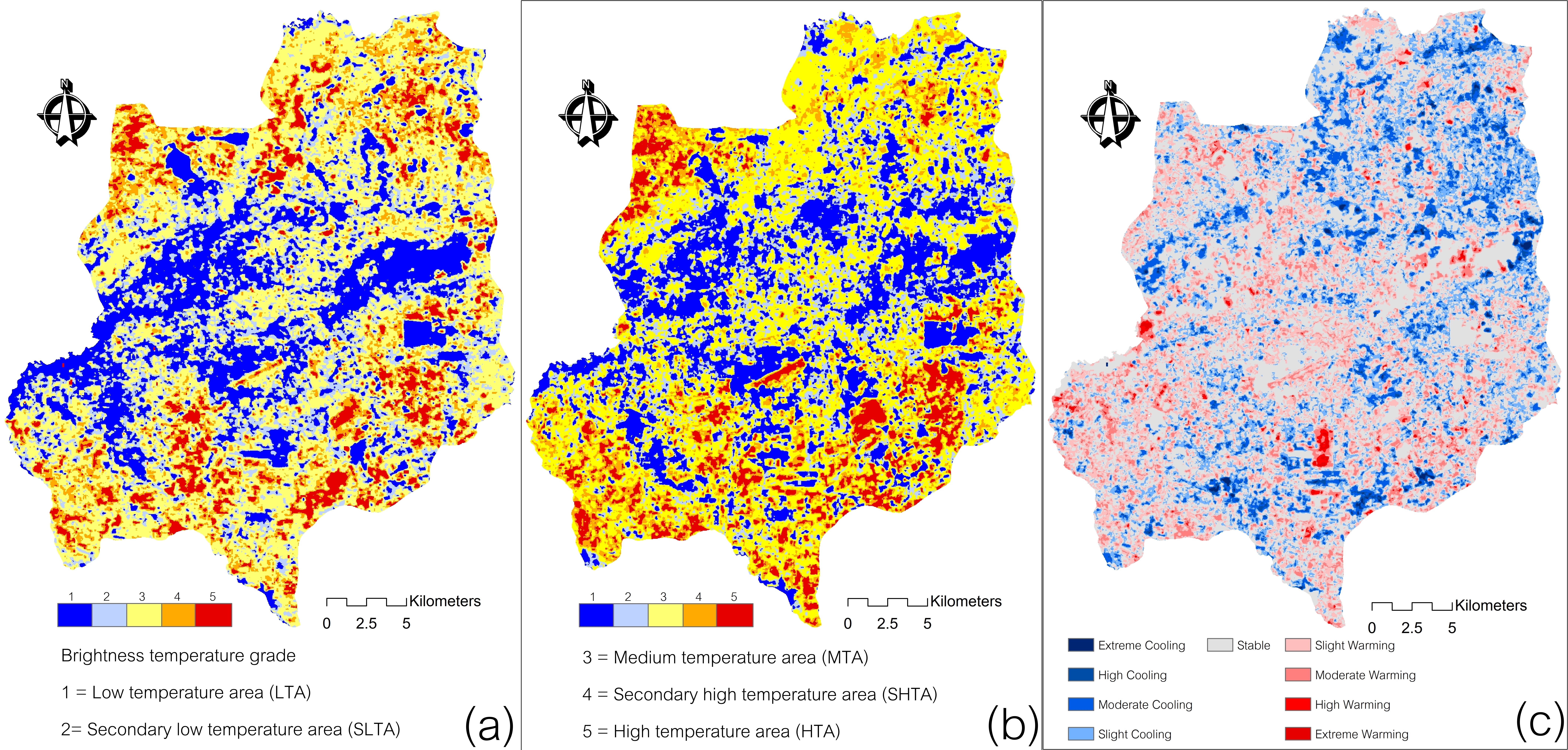
ผลการวิจัย : การวิเคราะห์เมทริกซ์การเปลี่ยนแปลง (Transition Matrix) แสดงให้เห็นการเปลี่ยนแปลงโครงสร้างของเมืองที่ชัดเจน พบว่าในช่วงเวลา 15 ปี พื้นที่ชุมชนและสิ่งปลูกสร้างมีการขยายตัวเพิ่มขึ้นสุทธิ 73.66 ตร.กม. คิดเป็นอัตราการเติบโตถึงร้อยละ 34.46 จากปีฐาน การขยายตัวนี้เกิดขึ้นจากการเปลี่ยนแปลงสภาพของพื้นที่เกษตรกรรม (55.32 ตร.กม.) และพื้นที่เบ็ดเตล็ด (23.35 ตร.กม.) เป็นหลัก ในขณะที่พื้นที่ป่าไม้ลดลงร้อยละ 49.83 สะท้อนถึงแรงกดดันจากการพัฒนาเมืองต่อทรัพยากรธรรมชาติ ผลการวิเคราะห์ทางสถิติของอุณหภูมิพื้นผิวในปี ค.ศ. 2021 แสดงให้เห็นข้อค้นพบที่สำคัญ คือ พื้นที่เมืองมีอุณหภูมิเฉลี่ย 28.4 องศาเซลเซียส ซึ่งสูงกว่าพื้นที่ป่าไม้ (25.40 องศาเซลเซียส) อย่างมีนัยสำคัญทางสถิติ (p < .001) โดยมีผลต่างเฉลี่ยประมาณ 2.99 องศาเซลเซียส ข้อค้นพบนี้มีความแตกต่างอย่างสิ้นเชิงกับข้อมูลปี ค.ศ. 2007 ซึ่งไม่พบความแตกต่างอย่างมีนัยสำคัญระหว่างอุณหภูมิของเมืองและป่าไม้ บ่งชี้ว่าโครงสร้างเมืองในปัจจุบันมีความหนาแน่นและคุณสมบัติในการกักเก็บความร้อนเพิ่มสูงขึ้นจนเกิดเป็นเกาะความร้อนที่ชัดเจน แม้ว่าอุณหภูมิเฉลี่ยภาพรวมของปี ค.ศ. 2021 จะลดลงเล็กน้อยเนื่องจากอิทธิพลของปรากฏการณ์ลานีญา (La Niña) แต่ดัชนี URI กลับชี้ให้เห็นการเปลี่ยนแปลงเชิงโครงสร้างที่น่ากังวล โดยสัดส่วนพื้นที่ที่มีระดับอุณหภูมิ สูงมาก (High Temperature Grade) ได้ขยายตัวเพิ่มขึ้นจากร้อยละ 7.30 เป็น 7.39 ของพื้นที่ศึกษา นอกจากนี้ การวิเคราะห์การถดถอยเชิงเส้น (Linear Regression) ยืนยันว่าดัชนีสิ่งปลูกสร้าง (NDBI) มีความสัมพันธ์เชิงบวกกับอุณหภูมิพื้นผิวอย่างมีนัยสำคัญ และค่าสัมประสิทธิ์ความชัน (Slope) ในปี ค.ศ. 2021 บ่งชี้ว่าพื้นผิวเมืองมีความไวต่อการสะสมความร้อนเพิ่มขึ้น
สรุปผลการวิจัย : การขยายตัวของเมืองนครราชสีมาในช่วง 15 ปีที่ผ่านมา ส่งผลให้ความเข้มข้นของปรากฏการณ์เกาะความร้อน (UHI Intensity) ทวีความรุนแรงขึ้นอย่างมีนัยสำคัญ โดยเปลี่ยนผ่านจากสภาวะที่มีสมดุลความร้อนใกล้เคียงกับพื้นที่ธรรมชาติในอดีต มาสู่สภาวะที่เป็นเกาะความร้อนอย่างเต็มรูปแบบในปัจจุบัน ผลการพิสูจน์ทางสถิติยืนยันว่าสัณฐานวิทยาของเมือง (Urban Morphology) เป็นปัจจัยหลักที่กำหนดอุณหภูมิพื้นผิว เหนือกว่าปัจจัยทางภูมิอากาศระดับภูมิภาคในเชิงพื้นที่ ข้อเสนอแนะเชิงนโยบายจากการศึกษานี้เน้นย้ำถึงความจำเป็นเร่งด่วนในการบูรณาการพื้นที่สีเขียวและแหล่งน้ำเข้าสู่ผังเมืองรวม เนื่องจากผลการศึกษาชี้ชัดว่าดัชนี MNDWI และ NDVI มีความสัมพันธ์เชิงลบกับอุณหภูมิ ซึ่งแปลว่าการเพิ่มพื้นที่เหล่านี้เป็นมาตรการที่มีประสิทธิภาพสูงสุดในการบรรเทาผลกระทบจากเกาะความร้อนและสร้างเสริมความยืดหยุ่นทางภูมิอากาศให้กับเมืองในอนาคต
เอกสารอ้างอิง
Anselin, L., Syabri, I., & Kho, Y. (2006). GeoDa: An introduction to spatial data analysis. Geographical Analysis, 38(1), 5–22. doi.org/10.1111/j.0016-7363.2005.00671.x
Alberti, M., Marzluff, J. M., Shulenberger, E., Bradley, G., Ryan, C., & Zumbrunnen, C. (2008). Integrating humans into ecology: Opportunities and challenges for studying urban ecosystems. Urban Ecology: An International Perspective on the Interaction Between Humans and Nature, 53(12), 143–158.
Andersson, E. (2006). Urban landscapes and sustainable cities. Ecology and Society, 11(1). doi.org/10.5751/ES-01639-110134
Baró, F., Haase, D., Gómez‐Baggethun, E., & Frantzeskaki, N. (2015). Mismatches between ecosystem services supply and demand in urban areas: A quantitative assessment in five European cities. Ecological Indicators, 55, 146-158. doi.org/10.1016/j.ecolind.2015.03.013.
Basara, J. B., Basara, H. G., Illston, B. G., & Crawford, K. C. (2010). The impact of the Urban Heat Island during an intense heat wave in Oklahoma City. Advances in Meteorology, 2010, 1–10. doi.org/10.1155/2010/230365
Chotchaiwong, P., & Wijitkosum, S. (2019). Relationship between land surface temperature and land use in Nakhon Ratchasima City, Thailand. Engineering Journal, 23(4), 1–14. doi.org/10.4186/ej.2019.23.4.1
Cook, M., Schott, J. R., Mandel, J., & Raqueno, N. (2014). Development of an operational calibration methodology for the Landsat thermal data archive and initial testing of the atmospheric compensation component of a Land Surface Temperature Product. Remote Sensing, 6(11), 11244-11266.
Cui, L., & Shi, J. (2012). Urbanization and its environmental effects in Shanghai, China. Urban Climate, 2, 1–15. doi.org/10.1016/j.uclim.2012.10.008
Curran, P. J. (1985). Principles of Remote Sensing. Longman, London.
Dan, S., Xu, H., Xue, W., He, J., & Dan, B. (2010). Comparison and analysis of research methods for urban heat island effect based on Landsat TM6. 2010 2nd IITA International Conference on Geoscience and Remote Sensing (IITA-GRS 2010), 1, 161–164. doi.org/10.1109/IITA-GRS.2010.5602992
Deng, X., Zhao, C., & Yan, H. (2013). Systematic modeling of impacts of land use and land cover changes on regional climate: A review. Advances in Meteorology, 2013, 1–11. doi.org/10.1155/2013/317678
Deng, Y., Wang, S., Bai, X., Tian, Y., Wu, L., Xiao, J., Chen, F., & Qian, Q. (2018). Relationship among land surface temperature and LUCC, NDVI in typical karst area. Scientific Reports, 8(1), 641. doi.org/10.1038/s41598-017-19088-x
Fitzpatrick-Lins, K. (1981). Comparison of sampling procedures and data analysis for a land-use and land-cover map. Photogrammetric Engineering and Remote Sensing, 47(3), 343-351.
Guechi, I., Gherraz, H., & Alkama, D. (2021). Correlation analysis between biophysical indices and Land Surface Temperature using remote sensing and GIS in Guelma city (Algeria). Bulletin de la Société Royale des Sciences de Liège. doi.org/10.25518/0037-9565.10457.
Guha, S., Govil, H., Gill, N., & Dey, A. (2020). Analytical study on the relationship between land surface temperature and land use/land cover indices. Annals of GIS, 26(2), 201–216. doi.org/10.1080/19475683.2020.1754291
Kalnay, E., & Cai, M. (2003). Impact of urbanization and land-use change on climate. Nature, 423(6939), 528–531. doi.org/10.1038/nature01675
Khamchiangta, D., & Dhakal, S. (2020). Time series analysis of land use and land cover changes related to urban heat island intensity: Case of Bangkok Metropolitan Area, Thailand. Journal of Urban Management, 9(4), 383-395.
Kometa, S. S., & Akoh, N. R. (2012). The hydro-geomorphological implications of urbanisation in Bamenda, Cameroon. Journal of Sustainable Development, 5(6). doi.org/10.5539/jsd.v5n6p64
Landis, J. R., & Koch, G. G. (1977). The measurement of observer agreement for categorical data. Biometrics, 33(1), 159–174. doi.org/10.2307/2529310
Lin, Y. P., Lin, Y. Bin, Wang, Y. T., & Hong, N. M. (2008). Monitoring and predicting land-use changes and the hydrology of the urbanized Paochiao watershed in Taiwan using remote sensing data, urban growth models and a hydrological model. Sensors, 8(2), 658–680. doi.org/10.3390/s8020658
Lundholm, J. T., & Richardson, P. J. (2010). Habitat analogues for reconciliation ecology in urban and industrial environments. Journal of Applied Ecology, 47(5), 966–975. doi.org/10.1111/j.1365-2664.2010.01857.x
McCarthy, M. P., Best, M. J., & Betts, R. A. (2010). Climate change in cities due to global warming and urban effects. Geophysical Research Letters, 37(9). doi.org/10.1029/2010GL042845
Meechai, W., Khonkaen, P., Chuesaard, T., et al. (2025). Impacts of El Niño and La Niña Phenomena on Land Surface Temperature Changes Due to Different Land Uses in Phrae Province. Thai Forest Ecological Research Journal, 9(1), 93-110. (in Thai)
Mushore, T. D., Dube, T., Manjowe, M., Gumindoga, W., Chemura, A., Rousta, I., Odindi, J., & Mutanga, O. (2019). Remotely sensed retrieval of Local Climate Zones and their linkages to land surface temperature in Harare metropolitan city, Zimbabwe. Urban Climate, 27, 259–271.
Nakhon Ratchasima Provincial Office. (2020). Nakhon Ratchasima Provincial Development Plan 2018–2022. Revised edition, fiscal year 2022. Strategy and Information for Provincial Development Group. Nakhon Ratchasima Provincial Office. (in Thai)
Njoku, E. A., & Tenenbaum, D. E. (2022). Quantitative assessment of the relationship between land use/land cover (LULC), topographic elevation and land surface temperature (LST) in Ilorin, Nigeria. Remote Sensing Applications: Society and Environment, 27, 100780. doi.org/10.1016/j.rsase.2022.100780
Ongsomwang, S., Dasananda, S., & Prasomsup, W. (2018). Spatio-Temporal Urban Heat Island Phenomena Assessment using Landsat Imagery: A Case Study of Bangkok Metropolitan and its Vicinity, Thailand. Environment and Natural Resources Journal 2018, 16(2), 29-44.
Saha, S., Saha, A., Das, M., Saha, A., Sarkar, R., & Das, A. (2021). Analyzing spatial relationship between land use/land cover (LULC) and land surface temperature (LST) of three urban agglomerations (UAs) of Eastern India. Remote Sensing Applications: Society and Environment, 22, 100507. doi.org/10.1016/j.rsase.2021.100507
Sobrino, J. A., Jiménez-Muñoz, J. C., Zarco-Tejada, P. J., Sepulcre-Cantó, G., & de Miguel, E. (2006). Land surface temperature derived from airborne hyperspectral scanner thermal infrared data. Remote Sensing of Environment, 102(1–2), 99–115. doi.org/10.1016/j.rse.2006.02.001
Stow, D. A., & Chen, D. M. (2002). Sensitivity of multitemporal NOAA AVHRR data of an urbanizing region to land-use/land-cover changes and misregistration. Remote Sensing of Environment, 80(2), 297–307. doi.org/10.1016/S0034-4257(01)00311-X
Tan, J., Yu, D., Li, Q., Tan, X., & Zhou, W. (2020). Spatial relationship between land-use/land-cover change and land surface temperature in the Dongting Lake area, China. Scientific Reports, 10(1), 9245. doi.org/10.1038/s41598-020-66168-6
Teuling, A. J., Seneviratne, S. I., Stöckli, R., Reichstein, M., Moors, E., Ciais, P., Luyssaert, S., van den Hurk, B., Ammann, C., Bernhofer, C., Dellwik, E., Gianelle, D., Gielen, B., Grünwald, T., Klumpp, K., Montagnani, L., Moureaux, C., Sottocornola, M., & Wohlfahrt, G. (2010). Contrasting response of European forest and grassland energy exchange to heatwaves. Nature Geoscience, 3(10), 722–727. doi.org/10.1038/ngeo950
Thai Meteorological Department. (2022). El Niño/La Niña Monitoring Report (February 21, 2022). Meteorological Development Division.
Thai Meteorological Department. (2023). Climatological data of Thailand for 30 year period (1991–2020) (Meteorological Data Report No. 551.586-13-2023). Bangkok: Thai Meteorological Department.
The jamovi project (2024). jamovi. (Version 2.6) [Computer Software]. Retrieved from https://www.jamovi.org.
Tucker, C. J. (1979). Red and photographic infrared linear combinations for monitoring vegetation. Remote Sensing of Environment, 8(2), 127–150. doi.org/10.1016/0034-4257(79)90013-0
U.S. Geological Survey. (2021). Landsat Collection 2 Level-2 Science Products (USGS Fact Sheet 2021-3055). U.S. Geological Survey. doi.org/10.3133/fs20213055
Voogt, J. A., & Oke, T. R. (2003). Thermal remote sensing of urban climates. Remote Sensing of Environment, 86(3), 370–384. doi.org/10.1016/S0034-4257(03)00079-8
Welch, B. L. (1951). On the comparison of several mean values: An alternative approach. Biometrika, 38(3/4), 330–336. doi.org/10.2307/2332579
Xu, H. (2006). Modification of normalised difference water index (NDWI) to enhance open water features in remotely sensed imagery. International Journal of Remote Sensing, 27(14), 3025–3033. doi.org/10.1080/01431160600589179
Xu, H. Q., & Chen, B. Q. (2004). Remote sensing of the urban heat island and its changes in Xiamen City of SE China. Journal of Environmental Sciences, 16, 276–281.
Yao, X., Wang, Z., & Wang, H. (2015). Impact of urbanization and land-use change on surface climate in middle and lower reaches of the Yangtze River, 1988–2008. Advances in Meteorology, 2015, 1–10. doi.org/10.1155/2015/395094
Zha, Y., Gao, J., & Ni, S. (2003). Use of normalized difference built-up index in automatically mapping urban areas from TM imagery. International Journal of Remote Sensing, 24(3), 583-594.
Zhao, H. Y., Guo, J. Q., Zhang, C. J., Sun, L. D., Zhang, X. D., Lin, J. J., Wang, Y. H., Fang, F., Ma, P. L., Liu, C. H., Li, Y. C., Fang, J. G., Li, L., Li, H. M., Zheng, G. F., Deng, Z. Y., & Dong, A. X. (2014). Climate change impacts and adaptation strategies in Northwest China. Advances in Climate Change Research, 5(1), 7–16.
Zhao, S., Peng, C., Jiang, H., Tian, D., Lei, X., & Zhou, X. (2006). Land use change in Asia and the ecological consequences. Ecological Research, 21(6), 890–896. doi.org/10.1007/s11284-006-0048-2
ดาวน์โหลด
เผยแพร่แล้ว
รูปแบบการอ้างอิง
ฉบับ
ประเภทบทความ
สัญญาอนุญาต
ลิขสิทธิ์ (c) 2026 คณะวิทยาศาสตร์ มหาวิทยาลัยบูรพา

อนุญาตภายใต้เงื่อนไข Creative Commons Attribution-NonCommercial-NoDerivatives 4.0 International License.
Burapha Science Journal is licensed under a Creative Commons Attribution-NonCommercial-NoDerivatives 4.0 International (CC BY-NC-ND 4.0) licence, unless otherwise stated. Please read our Policies page for more information