
Trematode Infections of Gastropods in Saraburi Province
Keywords:
trematode , cercaria, intermediate host , gastropod, Saraburi ProvinceAbstract
Background and Objectives : Gastropods are economically important and also play a significant role in medical malacology as intermediate hosts of various trematode parasites. Trematode infections of humans and animals are generally classified into four major groups: liver flukes, lung flukes, intestinal flukes, and blood flukes. Each trematode group is transmitted from the definitive host to freshwater snails that serve as the first intermediate host, where the larval stages multiply asexually to increase the number of trematode larvae within the snail. The cercarial stage released from snails then infect the second intermediate hosts and develop into metacercariae, the infective stage found in second intermediate hosts in aquatic animals such as shrimp, snails, crabs, and fish. These metacercarial stage develop into adult flukes in the definitive host following the consumption of raw or undercooked food, except for blood flukes, whose cercarial stage is infective and can directly penetrate the skin of humans and animals, causing schistosomiasis. Trematode infections are found in many areas of Thailand. Knowledge of the distribution of snails that can serve as intermediate hosts in aquatic habitats can provide important information for assessing the risk and epidemiology of trematode infections. Therefore, this study aimed to investigate trematode infections in gastropods and to identify the species of trematodes infecting gastropods in Saraburi Province, which is one of the provinces where outbreaks of paragonimiasis have previously been reported in Thailand.
Methodology : Snail samples were randomly collected from natural water sources at 13 sampling sites in 5 districts (Wang Muang, Muak Lek, Kaeng Khoi, Mueang Saraburi, and Sao Hai) in Saraburi Province, Thailand, in June 2023. Snails were collected by hand picking and scooping method using the counts per unit of time method, with five collectors sampled for 10 minutes at each site. Parasitic infections were examined using the shedding and crushing methods. For the shedding method, snails were placed individually in plastic cups containing dechlorinated water and maintained overnight, after which cercarial emergence was examined under a stereomicroscope. The emerging cercariae were described as the morphology based on living cercariae which unstained or vitally stained with 0.5% neutral red. Measurements in micrometers were taken from 10 specimens fixed with 10% formalin. For the crushing method, snail shells were cracked, and the digestive glands were then examined for larval trematodes under a light microscope to estimate trematode infection rates in the gastropods. Snail species and trematode larvae were identified based on morphological characteristics.
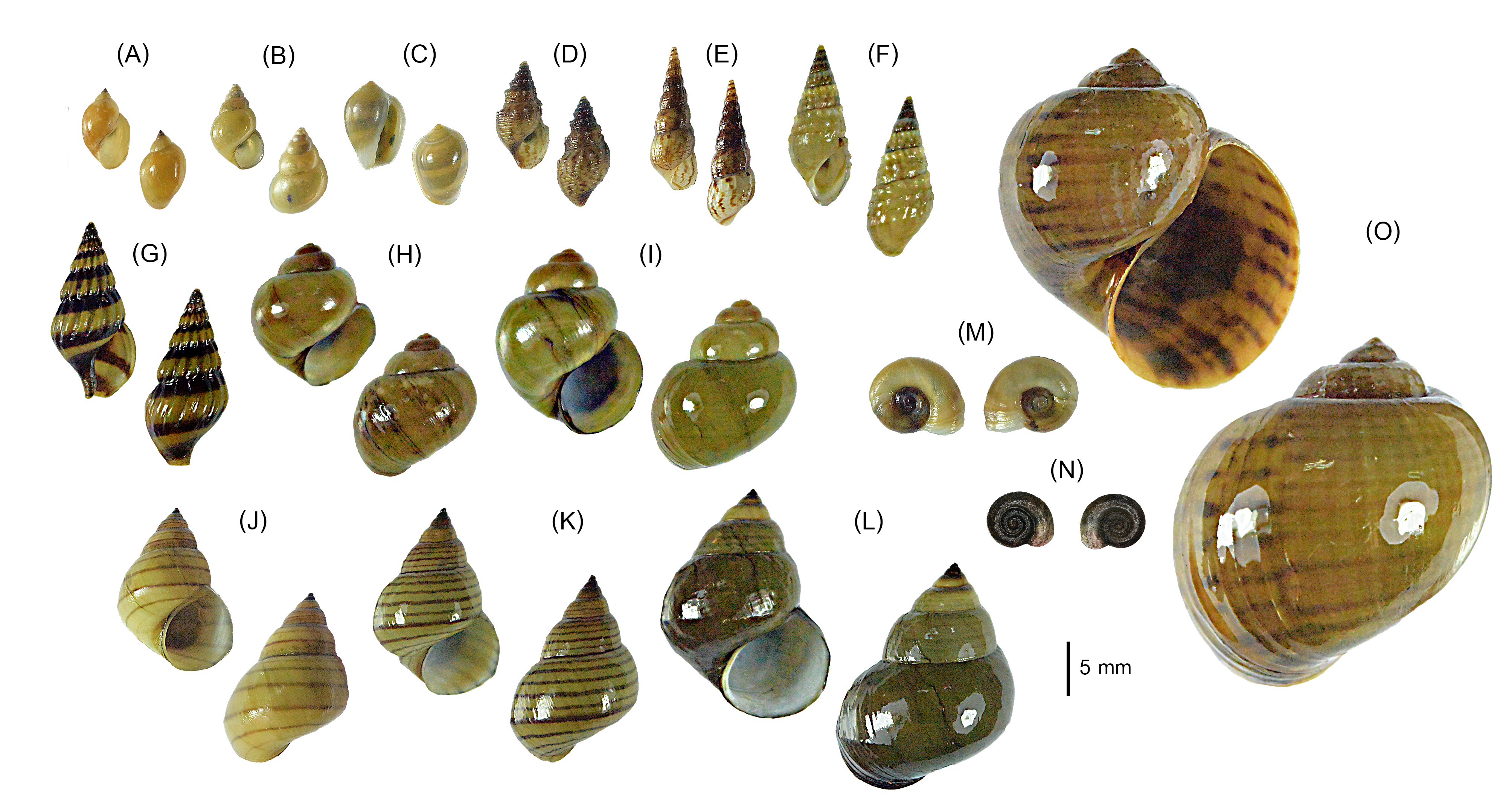
Main Results : A total of 970 snails were collected and identified morphologically into 15 species. The species identified were Radix rubiginosa (5), Bithynia siamensis siamensis (187), Rivomarginella morrisoni (1), Mieniplotia scabra (118), Melanoides tuberculata (8), Tarebia granifera (362), Anentome helena (183), Mekongia swainsoni braueri (8), M. s. swainsoni (2), Filopaludina filosa (1), F. sumatrensis polygramma (23), F. martensi martensi (63), Indoplanorbis exustus (6), Gyraulus convexiusculus (1) and Pomacea canaliculata (2). The prevalence of cercarial infection in snails was investigated using the shedding and crushing methods. Fourteen snails were found to be infected with cercarial larvae. A total infection rate of 1.44% (14/970). Infected snails were found in five snail species, with M. scabra exhibiting the highest infection prevalence. Cercariae were morphologically classified into three types and four species: type 1, Xiphidiocercariae (Maritreminoides obstipus and Loxogenoides bicolor); type 2, Cotylomicrocercous cercariae (Coitocaecum anaspidis); and type 3, Parapleurolophocercous cercariae (Acanthotrema tridactyla). However, this study identified several snail species in Saraburi Province that serve as the first intermediate hosts for various trematodes. The data showed that five snail species in the families Thiaridae (M. scabra, T. granifera), Viviparidae (F. s. polygramma, F. m. martensi), and Nassariidae (A. helena) can act as the first intermediate hosts for intestinal flukes, which develop into adult worms in fish, frogs, birds, and humans. Although the overall prevalence of trematode infections is low, the detection of medically important cercarial larvae is useful for assessing the potential risk of trematode infection.
Conclusions : These studies were found snails variation species from Saraburi province, Thailand. The snails were identified by shell morphology into 15 species consist of R. rubiginosa, B. s. siamensis, R. morrisoni, M. scabra, M. tuberculata, T. granifera, A. helena, M. s. braueri, M. s. swainsoni, F. filosa, F. s. polygramma, F. m. martensi, I. exustus, G. convexiusculus and P. canaliculata. Trematode infections in freshwater gastropods in Saraburi Province revealed five snail species acting as the first intermediate hosts: A. helena, M. scabra, T. granifera, F. m. martensi, and F. s. polygramma. Four species of intestinal trematode cercariae were identified: M. obstipus, L. bicolor, C. anaspidis, and A. tridactyla. In addition, A. tridactyla infected the highest number of gastropod species. Therefore, identifying cercarial species helps to assess the risk of trematode disease occurrence and to understand their adaptation in intermediate hosts. This information provides guidance for enhancing the effectiveness of trematode disease prevention and control in the country.
References
Al-Kandari, W. Y., Alnaqeeb, M. A., Isaac, A. M., & Al-Bustan, S. A. (2015). Molecular characterization of Stictodora tridactyla (Trematoda: Heterophyidae) from Kuwait Bay using rDNA ITS and mtCO1. Parasitology research, 114, 4259-4266.
Anantaphruti, M. T., Nawa, Y., & Vanvanitchai, Y. (2011). Human sparganosis in Thailand: an overview. Acta Tropica, 118, 171-176.
Apiraksena, K., Namchote, S., Komsuwan, J., Dechraksa, W., Tharapoom, K., Veeravechsukij, N., Glaubrecht, M., & Krailas, D. (2020). Survey of Stenomelania Fisher, 1885 (Cerithioidea, Thiaridae): The potential of trematode infections in a newly-recorded snail genus at the coast of Andaman Sea, South Thailand. Zoosystematics and Evolution, 96(2), 807-819.
Brandt, A. M. (1974). The non-marine aquatic Mollusca of Thailand. Frankfurt: Arch Moll Band 105.
Chai, J. Y. (2009). Echinostomes in humans. In R. Toledo & B. Fried (Eds.), The biology of echinostomes: from the molecule to the community (pp. 147–183). New York: Springer. https://doi.org/10.1007/978-0-387-09577-6_7
Chai, J. Y., Sohn, W. M., Na, B. K., & Nguyen, V. D. (2011). Echinostoma revolutum: metacercariae in Filopaludina snails from Nam Dinh Province, Vietnam, and adults from experimental hamsters. The Korean Journal of Parasitology, 49(4), 449-455. https://doi.org/10.3347/kjp.2011.49.4.449
Chantima, K., Chai, J.Y., & Wongsawad, C. (2013). Echinostoma revolutum: Freshwater Snails as the Second Intermediate Hosts in Chiang Mai, Thailand. The Korean Journal of Parasitology, 51(2), 183-189.
Chontananarth, T., & Wongsawad, C. (2013). Epidemiology of cercarial stage of trematodes in freshwater snails from Chiang Mai province, Thailand. Asian Pacific Journal of Tropical Biomedicine, 3(3), 237–243. https://doi.org/10.1016/s2221-1691(13)60058-1
Dechruksa, W., Glaubrecht, M., & Krailas, D. (2017). Natural trematode infections of freshwater snail Melanoides jugicostis Hanley & Theobald, 1876 (Family Thiaridae), the first intermediate host of animal and human parasites in Thailand. Silpakorn University Science and Technology Journal, 11(1), 9-16.
Dechruksa, W., Krailas, D., Ukong, S., Inkapatanakul, W., & Koonchornboon, T. (2007). Trematode infections of the freshwater snail family Thiaridae in the Khek river, Thailand. Southeast Asian Journal of Tropical Medicine and Public Health, 38(6), 1016-1028.
Ito, J. (1980). Studies on cercariae in Japan. Shizuoka: Shizuoka University Press.
Khosravi, M., Díaz-Morales, D. M., Thieltges, D. W., Wahl, M., & Vajedsamiei, J. (2023). Thermal optima of cercarial emergence in trematodes from a marine high-temperature ecosystem, the Persian Gulf. Scientific Reports, 13, 1-10. https://doi.org/10.1038/s41598-023-31670-0
Krailas, D., Chotesaengsri, S., Dechruksa, W., Namchote, S., Chuanprasit, C., Veeravechsukij, N., Boonmekam, D., & Koonchornboon, T. (2012). Species diversity of aquatic mollusks and their cercarial infections; Khao Yai National Park, Thailand. The Journal of Tropical Medicine and Parasitology, 35(2), 37-47.
Krailas D., Namchote S., Koonchornboon T., Dechruksa W., Boonmekam D. (2014). Trematodes obtained from the thiarid freshwater snail Melanoides tuberculata (Müller, 1774) as vector of human infections in Thailand. Zoosystematics and Evolution, 90(1), 57-86. https://doi.org/10.3897/zse.90.7306
Krailas, D., Namchote, S., Komsuwan, J., Wongpim, T., Apiraksena, K., Glaubrecht, M., Sonthiporn, P., Sansawang, C., & Suwanrit, S. (2022). Cercarial dermatitis outbreak caused by ruminant parasite with intermediate snail host: schistosome in Chana, South Thailand. Evolutionary Systematics, 6, 151–173. https://doi.org/10.3897/evolsyst.6.87670
Krairut, P., Thawnon-ngiw, B., & Kongim, B. (2020). Genetic diversity of genus Filopaludina in the upper northeastern Mekong Basin of Thailand revealed by mitochondrial DNA sequences. Interdisciplinary Research Review, 15(3). 39-43.
Macfarlane, V. W. (2009). Life cycle of Coitocaecum anaspidis Hickman, a New Zealand digenetic trematode. New Zealand Journal of Zoology, 31(2), 172-184.
Namchote, S., Sritongtae, S., Butnin, S., Wongwain, P., & Krailas, D. (2015). Larval stage of trematodes obtained from brackish water snails in the central and east coast of the Gulf of Thailand. Scientific Research and Essays, 10(11), 386–401. https://doi.org/10.5897/SRE2015.6160
Noikong, W., & Wongsawad, C. (2014). Epidemiology and molecular genotyping of echinostome metacercariae in Filopaludina snails in Lamphun Province, Thailand. Asian Pacific Journal of Tropical Medicine, 7(1), 26-29.
Olivier, L. J., & Schneiderman, M. (1956). A method for estimating the density of aquatic snail populations. Experimental Parasitology, 5, 109–117. https://doi.org/10.1016/0014-4894(56)90008-X
Pratumsrikajorn, P., Namchote, S., Boonmekam, D., Koonchornboon, T., Glaubrecht, M., & Krailas, D. (2017). Cercarial Infections of Freshwater Snail Genus Brotia in Thailand. Science, Engineering and Health Studies, 9-15.
Rungsiwiwat, A., Rayan, S., & Chartchumni, B. (2018). Abundance of freshwater gastropods and correlation with water quality in Nam Oun Reservoir, Sakon Nakhon Province. Journal of Science and Technology Ubon Ratchathani University, 21, 21-26. (in Thai)
Schell, S. C. (1962). Parasitology laboratory manual. New York & London: John Wiley & Sons, Inc.
Schell, S. C. (1970). How to know the Trematodes. Iowa: Wm. c. Brown Company Publishers.
Srisonti, D. (1997). Lung fluke. Bangkok: Living Transmedia. (in Thai)
Toledo, R., Alvarez-Izquierdo, M., Esteban, J. G., & Munoz-Antoli, C. (2022). Neglected food-borne trematodiases: echinostomiasis and gastrodiscoidiasis. Parasitology, 149(10), 1319-1326. https://doi.org/10.1017/S0031182022000385
Toledo, R., & Esteban, J. G. (2016). An update on human echinostomiasis. Transactions of the Royal Society of Tropical Medicine and Hygiene, 110(1), 37-45. https://doi.org/10.1093/trstmh/trv099
Ukong, S., Krailas, D., Dangprasert, T., & Channgarm, P. (2007, April). Studies on the morphology of cercariae obtained from freshwater snails at Erawan Waterfall, Erawan National Park, Thailand. The Southeast Asian Journal of Tropical Medicine and Public Health, 38(2), 302–312.
Upatham, E. S., Sornmani, S., Kittikoon, V., Lohachit, C., & Burch, J. B. (1983). Identification key for fresh and brackish water snails of Thailand. Malacological Review, 16, 107-132.
Veeravechsukij, N., Namchote, S., Neiber, M. T., Glaubrecht, M., & Krailas, D. (2018). Exploring the evolutionary potential of parasites: Larval stages of pathogen digenic trematodes in their thiarid snail host Tarebia granifera in Thailand. Zoosystematics and Evolution, 94(2), 425–460. https://doi.org/10.3897/zse.94.28793
Wiroonpan, P., Chontananarth, T., & Purivirojkul, W. (2021). Cercarial trematodes in freshwater snails from Bangkok, Thailand: prevalence, morphological and molecular studies and human parasite perspective. Parasitology, 148(3), 366-383. https://doi.org/10.1017/S0031182020002073
Wongpim, T., Komsuwan, J., Janmanee, C., Thongchot, P., Limsampan, S., Wichiannarat, N., Chaowatut, W., Suwanrat, S., Dechruksa, W., Veeravechsukij, N., Glaubrecht, M., & Krailas, D. (2023). Freshwater pulmonate snails and their potential role as trematode intermediate host in a cercarial dermatitis outbreak in Southern Thailand. Evolutionary systematics, 7(2), 293-315.
Yamaguti, S. (1975). A synoptical review of life histories of digenetic Trematode of Vertebrates. Tokyo: Keigaku publishing.
Yoonuan, T., Vanvanitchai, Y., Dekumyoy, P., Komalamisra, C., Kojima, S., & Waikagul, J. (2008). Paragonimiasis prevalences in Saraburi province, Thailand, measured 20 years apart. The Southeast Asian Journal of Tropical Medicine and Public Health, 39(4), 593 – 600.
Downloads
Published
How to Cite
Issue
Section
License
Copyright (c) 2026 Faculty of Science, Burapha University

This work is licensed under a Creative Commons Attribution-NonCommercial-NoDerivatives 4.0 International License.
Burapha Science Journal is licensed under a Creative Commons Attribution-NonCommercial-NoDerivatives 4.0 International (CC BY-NC-ND 4.0) licence, unless otherwise stated. Please read our Policies page for more information