
Improving The Texture of Low-Sodium Fish Cakes Using Agar Extract from Gracilaria fisheri by Hot Water and Alkaline Methods
Keywords:
agar extracted, hot water extraction method, pre-alkaline extraction method, low sodium fish cake, textureAbstract
Background and Objectives: Conventional fish cakes typically contain approximately 2–3% salt to promote myofibrillar protein solubilization and gel formation; however, salt reduction often compromises texture, water holding capacity, and overall product quality. Thailand’s coastal regions are rich in edible red seaweeds, particularly Gracilaria fisheri (G. fisheri) in southern Thailand, presenting strong potential for health oriented food applications. The functional properties of agar are highly dependent on extraction methods, which in turn affect its physicochemical characteristics and performance in food systems, particularly under sodium reduced conditions. Despite extensive documentation of individual extraction techniques, comparative evidence linking extraction induced physicochemical differences of agar to textural performance in low sodium food systems remains limited. In addition, G. fisheri derived agar offers sustainability benefits by supporting coastal livelihoods and environmental health. However, its application as a texture modifying agent in low sodium seafood products where salt reduction compromises protein gelation has not been systematically investigated. In particular, the comparative performance of agar obtained via the hot water extraction method (HWEM) and the pre-alkaline extraction method (PAEM) in restructured fish cakes under low sodium conditions, as well as their relationships with key textural attributes hardness, springiness, cohesiveness, and chewiness remain unclear. Therefore, this study evaluates G. fisheri agar extracted by HWEM and PAEM as functional texturizers in low sodium fish cakes, focusing on physicochemical properties, textural performance, and potential for sustainable sodium reduced product development.
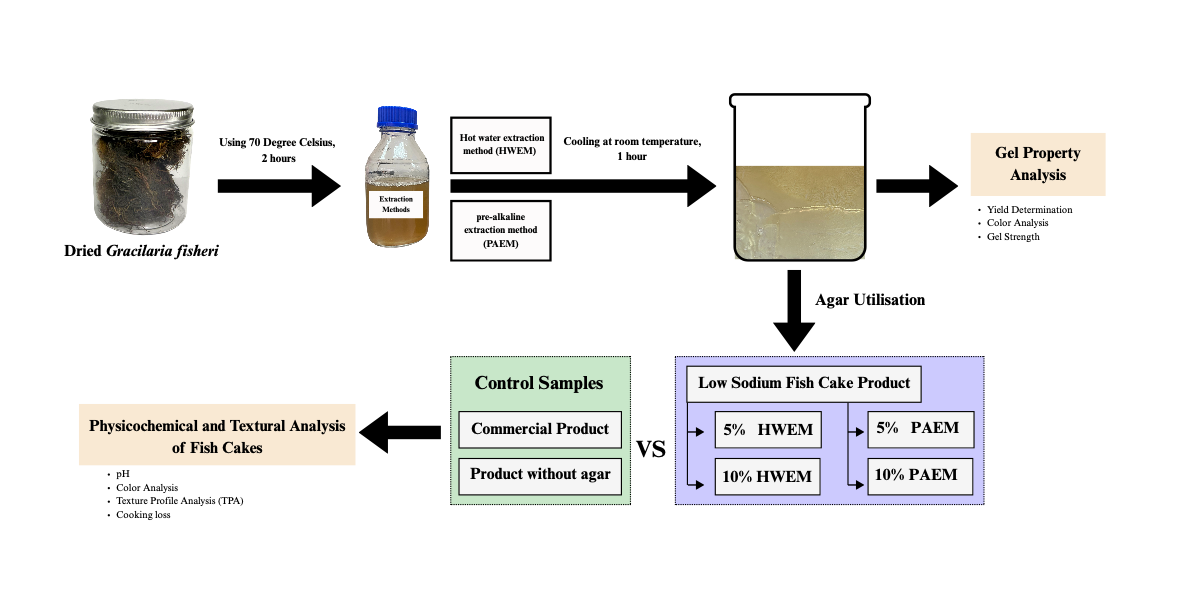
Methodology: Fresh G. fisheri seaweed was collected from southern Thailand, washed, and dried before agar extraction. Two methods the hot water extraction method (HWEM) and the pre-alkaline extraction method (PAEM) were applied. For HWEM, dried seaweed was extracted in deionized water, while PAEM involved NaOH pretreatment followed by hot water extraction. Extracted agar solutions were filtered, cooled, and stored for analysis. Agar yield, color (L*, a*, b*), and gel strength were determined using standard analytical methods. Low sodium fish cakes were prepared from tilapia fillets using five formulations (1% salt), varying by agar type (HWEM or PAEM) and concentration (5% and 10%), and compared with a control (no agar) and a commercial product (2% salt). Fish cakes were steamed, cooled, and analyzed for pH, color, cooking loss, and texture profile parameters, including hardness, springiness, and gumminess.
Main Results: This study evaluated the effects of two agar extraction methods, HWEM and PAEM, on the physicochemical properties of agar derived from G. fisheri and its functionality as a texturizing agent in low sodium fish cakes. Agar yield, gel characteristics, and color were first examined. PAEM (29.12%) produced a significantly higher agar yield than HWEM (19.94%), confirming the role of alkaline pretreatment in enhancing agar recovery. However, agar obtained by HWEM exhibited superior gel strength at 0.46 ± 0.02 gforce/mm2, indicating better gel network integrity, which are desirable attribute for food applications requiring visual clarity. In contrast, PAEM agar showed lower gel strength at 0.32 ± 0.02 gforce/mm2, likely due to polysaccharide degradation and structural modification during alkaline treatment. Food application part, Low sodium fish cakes (1% salt) were formulated with agar extracted by HWEM or PAEM at 5% and 10% concentrations and compared with a control and a commercial product (2% salt). Agar addition significantly influenced textural and physicochemical properties (p<0.05). Fish cakes containing HWEM agar exhibited increased hardness and gumminess with increasing agar concentration (from 5% to 10% agar), while springiness remained relatively unchanged. In contrast, PAEM agar resulted in slightly reduced hardness (207.49 ± 21.58 N at 5% agar and 202.66 ± 29.22 N at 10% agar) and gumminess at higher concentrations, possibly due to over aggregation and weakened gel cohesiveness. These results demonstrate that agar can compensate for reduced salt-induced protein gelation and maintain desirable texture in low sodium formulations. Cooking loss decreased with increasing agar concentration for both extraction methods, reflecting improved water holding capacity. Agar supplemented samples showed cooking loss values comparable to the commercial product, was not significant differences (p>0.05), despite containing half the salt level, highlighting agar’s effectiveness in yield retention. Fish cake pH values were slightly higher in PAEM treatments due to residual alkali, but remained within acceptable limits. No significant differences in lightness (L*) were observed among fish cake samples containing 5% and 10% agar from either extraction method (p > 0.05); however, the commercial product showed the highest L* value. From a commercial and sustainability perspective, HWEM offers a clean label, environmentally friendly approach suitable for health-oriented and premium food products, while PAEM provides higher yields and firmer gels for industrial applications. Together, these findings demonstrate the potential of G. fisheri agar to support sodium reduction, enhance product quality, and contribute to sustainable food and bioeconomy development in Thailand.
Conclusions: Both HWEM and PAEM produced functional agars from G. fisheri suitable for low sodium meat products, though with distinct advantages. PAEM yielded a higher extraction efficiency and enhanced water retention, supporting its applicability in industrial scale processing despite the requirement for alkaline neutralization. In contrast, HWEM offered an environmentally friendly alternative with simpler processing and lighter color, supporting health oriented and sustainable product development. Adopting a dual path strategy enables Thailand to reduce dependence on imported agar, enhance local value chains, and support coastal community livelihoods. The utilization of locally sourced seaweed aligns with BCG economy principles, food security objectives, and sustainable marine resource management.
References
Agar agar Imports in Thailand—Import data with price, buyer, supplier, HSN code. (2023). Retrieved from https://www.volza.com/p/agar-agar/import/import-in-thailand/
Ahmad, R., Surif, M. B., Ramli, N., & Yahya, N. (2011). A Preliminary Study on the Agar Content and Agar Gel Strength of Gracilaria manilaensis Using Different Agar Extraction Processes. Retrieved from https://www.semanticscholar.org/paper/A-Preliminary-Study-on-the-Agar-Content-and-Agar-of-Ahmad-Surif/49a502892292d465605e474785aad0665adcb7d5
Awad, A. M., Kumar, P., Ismail-Fitry, M. R., Jusoh, S., Ab Aziz, M. F., & Sazili, A. Q. (2021). Green Extraction of Bioactive Compounds from Plant Biomass and Their Application in Meat as Natural Antioxidant. Antioxidants, 10(9), 1465.
Cebrián-Lloret, V., Martínez-Abad, A., López-Rubio, A., & Martínez-Sanz, M. (2024). Exploring alternative red seaweed species for the production of agar-based hydrogels for food applications. Food Hydrocolloids, 146, 109177. doi.org/10.1016/j.foodhyd.2023.109177
Du, X., Zhao, M., Pan, N., Wang, S., Xia, X., & Zhang, D. (2021). Tracking aggregation behaviour and gel properties induced by structural alterations in myofibrillar protein in mirror carp (Cyprinus carpio) under the synergistic effects of pH and heating. Food Chemistry, 362, 130222. doi.org/10.1016/j.foodchem.2021.130222
Fiorentini, M., Kinchla, A. J., & Nolden, A. A. (2020). Role of Sensory Evaluation in Consumer Acceptance of Plant-Based Meat Analogs and Meat Extenders: A Scoping Review. Foods, 9(9), 1334.
Freilepelegrin, Y. (2005). Agars from three species of Gracilaria (Rhodophyta) from Yucatn Peninsula. Bioresource Technology, 96(3), 295–302.
Freile-Pelegrín, Y., & Madera-Santana, T. J. (2017). Biodegradable Polymer Blends and Composites from Seaweed(Cebrián-Lloret et al., 2024)s. In Handbook of Composites from Renewable Materials (pp. 419–438). John Wiley & Sons, Ltd.
Freile-Pelegrı́n, Y., & Murano, E. (2005). Agars from three species of Gracilaria (Rhodophyta) from Yucatán Peninsula. Bioresource Technology, 96(3), 295–302.
Huff-Lonergan, E., & Lonergan, S. M. (2005). Mechanisms of water-holding capacity of meat: The role of postmortem biochemical and structural changes. Meat Science, 51st International Congress of Meat Science and Technology (ICoMST), 71(1), 194–204. doi.org/10.1016/j.meatsci.2005.04.022
Huff-Lonergan, E., & Lonergan, S. M. (2005). Mechanisms of water-holding capacity of meat: The role postmortem biochemical and structural changes. Meat Science, 71(1), 194–204.
Hwang, H.-J., Choi, S.-Y., & Lee, S.-C. (2013). Preparation and quality analysis of sodium-reduced fried fish cakes. Preventive Nutrition and Food Science, 18(3), 222–225. doi.org/10.3746/pnf.2013.18.3.222
Imeson, A. (2010). Food Stabilisers, Thickeners and Gelling Agents. Wiley.Com. Retrieved from https://www.wiley.com/en-hk/Food+Stabilisers%2C+Thickeners+and+Gelling+Agents-p-9781405132671
Jiang, C., Chen, Y., Li, S., Shang, S., Fu, B., Wang, L., Dong, X., & Jiang, P. (2022). Ready-to-Eat Fish Cake Processing Methods and the Impacts on Quality and Flavor. Foods, 11(21), 3321.
Kim, T.-K., Yong, H. I., Jang, H. W., Kim, Y.-B., Sung, J.-M., Kim, H.-W., & Choi, Y.-S. (2020). Effects of hydrocolloids on the quality characteristics of cold-cut duck meat jelly. Journal of Animal Science and Technology, 62(4), 587–594.
Knierim, L., Uhl, A., Schmidt, A., Flemming, M., Höß, T., Treutwein, J., & Strube, J. (2024). Pressurized Hot Water Extraction as Green Technology for Natural Products as Key Technology with Regard to Hydrodistillation and Solid–Liquid Extraction. ACS Omega, 9(29), 31998–32010.
Kraithong, S., & Rawdkuen, S. (2020). Effects of food hydrocolloids on quality attributes of extruded red Jasmine rice noodle. PeerJ, 8, e10235.
Li, J., Ye, G., Wang, J., Gong, T., Wang, J., Zeng, D., Cifuentes, A., Ibañez, E., Zhao, H., & Lu, W. (2025). Recent advances in pressurized hot water extraction/modification of polysaccharides: Structure, physicochemical properties, bioactivities, and applications. Comprehensive Reviews in Food Science and Food Safety, 24(1), e70104.
Martínez-Sanz, M., Gómez-Mascaraque, L. G., Ballester, A. R., Martínez-Abad, A., Brodkorb, A., & López-Rubio, A. (2019a). Production of unpurified agar-based extracts from red seaweed Gelidium sesquipedale by means of simplified extraction protocols. Algal Research, 38, 101420.
Masniyom, P., & Benjama, O. (2012). Biochemical composition and physicochemical properties of two red seaweeds (Gracilaria fisheri and G. tenuistipitata) from the Pattani Bay in Southern Thailand. Songklanakarin Journal of Science and Technology (SJST), 34(2), 223–230.
Ni, N., Wang, Z., He, F., Wang, L., Pan, H., Li, X., Wang, Q., & Zhang, D. (2014). Gel properties and molecular forces of lamb myofibrillar protein during heat induction at different pH values. Process Biochemistry, 49(4), 631–636. doi.org/10.1016/j.procbio.2014.01.017
Pandya, Y. H., Bakshi, M., & Sharma, A. (2022). Agar-agar extraction, structural properties and applications: A review. The Pharma Innovation Journal, 11(6S), 1151–1157.
Park, J. W. (Ed.). (2013). Historical Review of Surimi Technology and Market Developments. In Surimi and Surimi Seafood (3rd ed.). CRC Press.
Pirsa, S., & Hafezi, K. (2023). Hydrocolloids: Structure, preparation method, and application in food industry. Food Chemistry, 399, 133967.
Plaza, M., & Turner, C. (2015). Pressurized hot water extraction of bioactives. TrAC Trends in Analytical Chemistry,71, 39–54.
Praiboon, J., Chirapart, A., Akakabe, Y., Bhumibhamon, O., & Kajiwara, T. (2006). Physical and Chemical Characterization of Agar Polysaccharides Extracted from the Thai and Japanese Species of Gracilaria. Science Asia, 32(s1), 011.
Ramírez, J. A., Uresti, R. M., Velazquez, G., & Vázquez, M. (2011). Food hydrocolloids as additives to improve the mechanical and functional properties of fish products: A review. Food Hydrocolloids, 25(8), 1842–1852.
Santana, P., Huda, N., & Yang, T. A. (2013). The Addition of Hydrocolloids (Carboxymethylcellulose, Alginate and Konjac) to Improve the Physicochemical Properties and Sensory Characteristics of Fish Sausage Formulated with Surimi Powder. Turkish Journal of Fisheries and Aquatic Sciences, 13(4), 561–569.
Shen, H., Zhao, M., & Sun, W. (2019). Effect of pH on the interaction of porcine myofibrillar proteins with pyrazine compounds. Food Chemistry, 287, 93–99. doi.org/10.1016/j.foodchem.2019.02.060
Sinthusamran, S., Benjakul, S., & Hemar, Y. (2016). Rheological and sensory properties of fish gelatin gels as influenced by agar from Gracilaria tenuistipitata. International Journal of Food Science & Technology, 51(6), 1530–1536.
Sipahutar, Y. H., Taufiq, T., Kristiani, M. G. E., Prabowo, D. H. G., Ramadheka, R. R., Suryanto, M. R., & Pratama, R. B. (2020). The effect of Gracilaria powder on the characteristics of nemipterid fish sausage. IOP Conference Series: Earth and Environmental Science, 404(1), 012033.
Smirnov, V., Khramova, D., Chistiakova, E., Zueva, N., Vityazev, F., Velskaya, I., & Popov, S. (2025). Texture Perception and Chewing of Agar Gel by People with Different Sensitivity to Hardness. Gels, 11(1), 5.
Sutloet P, & Sompongse W. (2016). Effect of Gracilaria fisheri extract on characteristics of fish emulsion sausage. Retrived from https://kukr.lib.ku.ac.th/kukr_es/index.php/covid19/search_detail/result/333381%0A%0A%0A%0A%0A%0A
Wang, L., Shen, Z., Mu, H., Lin, Y., Zhang, J., & Jiang, X. (2017). Impact of alkali pretreatment on yield, physico- chemical and gelling properties of high-quality agar from Gracilaria tenuistipitata. Food Hydrocolloids, 70, 356–362.
Wongthahan, P., & Thawornchinsombut, S. (2015). Quality Improvement of Reduced-Salt, Phosphate-Free Fish Patties from Processed By-Products of Nile Tilapia Using Textural Additives and Bioactive Rice Bran Compounds. Journal of Texture Studies, 46(4), 240–253. doi.org/10.1111/jtxs.12122
Xiao, Q., Wang, X., Zhang, J., Zhang, Y., Chen, J., Chen, F., & Xiao, A. (2021). Pretreatment Techniques and Green Extraction Technologies for Agar from Gracilaria lemaneiformis. Marine Drugs, 19(11), 617.
Yakhin, L. A., Wijaya, K. M., & Santoso, J. (2013). Peningkatan Kualitas Gel Sosis Ikan Lele dengan Penambahan Tepung Gracillaria gigas. Jurnal Pengolahan Hasil Perikanan Indonesia, 16(2).
Yarnpakdee, S., Benjakul, S., & Kingwascharapong, P. (2015). Physico-chemical and gel properties of agar from Gracilaria tenuistipitata from the lake of Songkhla, Thailand. Food Hydrocolloids, 51, 217–226.
Yudiati, E., Nugroho, A. A., Sedjati, S., Arifin, Z., & Ridlo, A. (2021). The Agar Production, Pigment and Nutrient Content in Gracilaria sp. Grown in Two Habitats with Varying Salinity and Nutrient Levels. Jordan Journal of Biological Sciences, 14(4), 755–761.
Zhang, T., Yuan, Y., Wu, X., Yu, P., Ji, J., Chai, J., Kumar Saini, R., Liu, J., & Shang, X. (2023). The level of sulfate substitution of polysaccharide regulates thermal-induced egg white protein gel properties: The characterization of gel structure and intermolecular forces. Food Research International, 173, 113349. doi.org/10.1016/j.foodres.2023.113349
Zhou, Y., Liu, J. J. H., Kang, Y., Cui, H., & Yang, H. (2021). Effects of acid and alkaline treatments on physicochemical and rheological properties of tilapia surimi prepared by pH shift method during cold storage. Food Research International, 145, 110424. doi.org/10.1016/j.foodres.2021.110424
Zhu, Y., Lu, Y., Ye, T., Jiang, S., Lin, L., & Lu, J. (2021). The Effect of Salt on the Gelling Properties and Protein Phosphorylation of Surimi-Crabmeat Mixed Gels. Gels, 8(1), 10.
Ziedan, E. S. H., Zahaby, H. M. E., Maswada, H. F., & Zoeir, E. H. A. E. R. (2018). Agar-agar a promising edible coating agent for management of postharvest diseases and improving banana fruit quality. Journal of Plant Protection Research, 58(3), 234–240.
Downloads
Published
How to Cite
Issue
Section
License
Copyright (c) 2026 Faculty of Science, Burapha University

This work is licensed under a Creative Commons Attribution-NonCommercial-NoDerivatives 4.0 International License.
Burapha Science Journal is licensed under a Creative Commons Attribution-NonCommercial-NoDerivatives 4.0 International (CC BY-NC-ND 4.0) licence, unless otherwise stated. Please read our Policies page for more information