
ผลของการดึงน้ำออกด้วยวิธีออสโมซิสต่อคุณลักษณะและสมบัติทางเคมีกายภาพของผลิตภัณฑ์อาหารจากพืชทอดกรอบด้วยเครื่องทอดแบบสุญญากาศ
คำสำคัญ:
ผลิตภัณฑ์อาหารว่างทอดกรอบจากโปรตีนพืช , กระบวนการเตรียมก่อนการทอด , กระบวนการดึงน้ำออกด้วยแรงดันออสโมซิส , การวิเคราะห์เชิงกลแบบไดนามิก , สมบัติทางเคมีกายภาพบทคัดย่อ
วัตถุประสงค์และที่มา : ผลิตภัณฑ์ทอดกรอบส่วนใหญ่มักพบว่ามีปริมาณน้ำมันในอาหารสูงเนื่องจากการแลกเปลี่ยนระหว่างน้ำและน้ำมันในอาหารระหว่างการทอด การดึงน้ำออกจากวัตถุดิบก่อนการทอดจะช่วยลดความชื้นในอาหารให้ลดลงซึ่งส่งผลให้ผลิตภัณฑ์ทอดมีการอมน้ำมันน้อยลง อีกทั้งการทอดสุญญากาศสามารถลดปริมาณน้ำมันในอาหารทอดลงเมื่อเปรียบเทียบกับการทอดในบรรยากาศปกติ เนื่องจากน้ำในวัตถุดิบระเหยไปภายใต้สภาวะสุญญากาศ นอกจากนั้นอุณหภูมิที่ใช้ทอดส่งผลต่อคุณลักษณะของผลิตภัณฑ์ทอด โดยพบว่าบริเวณ glass transition ของผลิตภัณฑ์อาหาร เป็นบริเวณที่โมเลกุลของอาหารมี molecular mobility สูง ทำให้ผลิตภัณฑ์มีความนิ่มและอ่อนตัวเป็นสาเหตุให้น้ำในอาหารสามารถเคลื่อนตัวได้ง่ายขึ้น ดังนั้นวัตถุประสงค์ของวิจัย คือ ศึกษาผลของวิธีการเตรียมวัตถุดิบก่อนการทอด (Pre-treatment) ที่มีต่อคุณลักษณะของผลิตภัณฑ์อาหารจากโปรตีนพืชทอดกรอบด้วยการดึงน้ำออกด้วยวิธีออสโมซิส (Osmosis dehydration; OD) ก่อนนำไปทอดด้วยเครื่องทอดแบบสุญญากาศ และศึกษาสมบัติทางความร้อน (Thermal properties) ของผลิตภัณฑ์อาหารทอดด้วยการวิเคราะห์ค่า glass transition temperature และ α-relaxation โดยใช้เครื่อง Differential Scanning Calorimeter (DSC) และ Dynamic Mechanical Analyzer (DMA) ตามลำดับ แล้วนำค่าที่ได้มาศึกษาความสัมพันธ์ของการเปลี่ยนแปลงคุณลักษณะด้านเนื้อสัมผัสและสมบัติทางเคมีกายภาพของผลิตภัณฑ์อาหารทอด และสามารถนำข้อมูลที่ได้ไปเป็นแนวทางประยุกต์ใช้ในอุตสาหกรรมอาหารทอดกรอบอื่นๆต่อได้
วิธีดำเนินการวิจัย : ในการศึกษาครั้งนี้ผลิตภัณฑ์เนื้อเลียนแบบจากพืชจะแบ่งออกเป็น 2 กลุ่ม คือ กลุ่มที่ไม่ผ่านกรรมวิธีการเตรียมก่อนการทอด (Control) และกลุ่มที่ผ่านกรรมวิธีการเตรียมก่อนการทอดด้วยการดึงน้ำออกด้วยวิธีการออสโมซิส (Osmosis dehydration; OD) ด้วยสารละลายเกลือ (NaCl) เข้มข้นร้อยละ 0.5 โดยน้ำหนัก โดยนำตัวอย่างผลิตภัณฑ์ที่ผ่านสไลด์แล้วประมาณ 200 กรัม ใส่ลงกะละมังที่มีสารละลายเกลือ (NaCl) ในอัตราส่วน 1 : 10 (ตัวอย่างต่อสารละลายเกลือ) ตั้งทิ้งไว้ที่อุณหภูมิห้องเป็นเวลา 30 นาที เป็นเวลา 1 ชั่วโมง เทสารละลายน้ำเกลือออกซับน้ำส่วนเกินที่เหลือด้วยกระดาษทิชชู่ นำตัวอย่างทั้ง 2 กลุ่มไปทอดด้วยเครื่องทอดสุญญากาศที่ความดันประมาณ 13.33 kPa เป็นเวลา 3 ชั่วโมง นำผลิตภัณฑ์ทอดที่ได้ไปวิเคราะห์สมบัติทางเคมีกายภาพของผลิตภัณฑ์หลังการทอด ได้แก่ การหดตัว การสูญเสียน้ำหนัก ค่าเนื้อสัมผัสด้วยเครื่องวิเคราะห์เนื้อสัมผัส ค่า Glass transition (Tg) ด้วยเครื่อง Differential Scanning Calorimetry (DSC) และค่า Storage modulus (E’) ด้วยเครื่อง Dynamic Mechanical Analyzer (DMA)
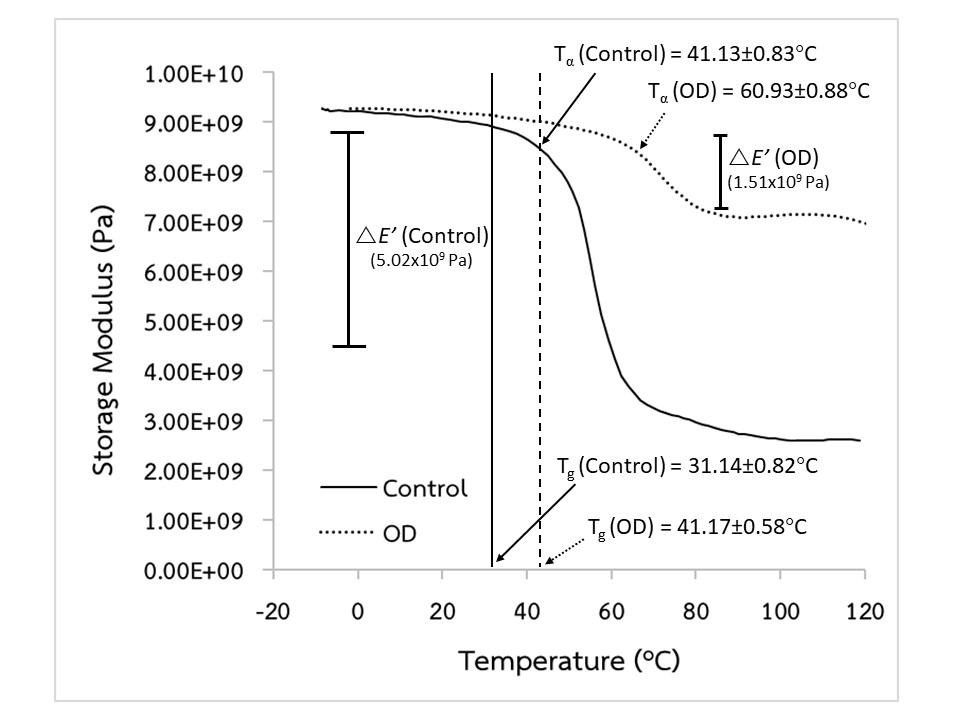
ผลการวิจัย : วิธีการเตรียมก่อนการทอดมีผลต่อคุณลักษณะและสมบัติทางเคมีกายภาพของผลิตภัณฑ์ทอดอย่างมีนัยสำคัญทางสถิติ (p≤0.05) โดยอัตราส่วนของการหดตัว, ร้อยละการสูญเสียความชื้น, ร้อยละปริมาณความชื้น, ร้อยละปริมาณไขมัน และเนื้อสัมผัสของผลิตภัณฑ์หลังการทอดของกลุ่ม Control มีค่าเท่ากับ 2.53±0.15, 88.6±0.82, 6.90±0.49, 4.36±0.18 และ 214.96±1.17 N ตามลำดับ ส่วนผลิตภัณฑ์ที่ผ่านวิธีการ OD มีอัตราการหดตัว, ร้อยละการสูญเสีย, ร้อยละปริมาณความชื้น, ร้อยละปริมาณไขมัน และเนื้อสัมผัสของผลิตภัณฑ์หลังการทอด เท่ากับ 1.29±0.08, 93.4±0.51, 3.22±0.54, 3.42±0.26 และ 115.20±1.20 N ตามลำดับ นอกจากนั้นสมบัติด้านความร้อน (Thermal properties) ของผลิตภัณฑ์ที่ผ่านวิธีการ OD ได้แก่ glass transition temperature (Tg) และ α-relaxation temperature (Tα) มีค่าสูงกว่ากลุ่ม Control อย่างมีนัยสำคัญทางสถิติ (p≤0.05) โดยค่า Tg และ Ta ของวิธี OD เท่ากับ 41.17±0.58 และ 60.93±0.88 ºC ตามลำดับ และบริเวณ glass transition ของผลิตภัณฑ์ทอดที่ผ่านวิธีการ OD มีการเปลี่ยนแปลงทางกล (storage modulus, ∆E’) น้อยกว่าผลิตภัณฑ์กลุ่ม Control โดย ∆E’ ของวิธี OD มีค่าเท่ากับ 1.51x10⁹ ในขณะที่ค่า ∆E’ ของผลิตภัณฑ์กลุ่มควบคุม เท่ากับ 5.02x10⁹ ที่อุณหภูมิ 35 ºC ค่า Force (hardness) ของผลิตภัณฑ์กลุ่ม OD มีค่าเท่ากับ 115 N ในขณะที่ค่า Force (hardness) ของผลิตภัณฑ์กลุ่มควบคุมเท่ากับ 215 N ซึ่งดูเหมือนว่าอุณหภูมิในการเก็บรักษาส่งผลต่อค่าเนื้อสัมผัสของผลิตภัณฑ์ทอด ค่า Force ที่เพิ่มขึ้นเมื่ออุณหภูมิในการเก็บเพิ่มขึ้น ค่า Force ของผลิตภัณฑ์กลุ่มควบคุมมีค่าในช่วง 215-250 N ซึ่งค่า ∆E’ มีความสัมพันธ์กับค่าเนื้อสัมผัสของผลิตภัณฑ์บริเวณ glass transition
สรุปผลการวิจัย : วิธีการเตรียมก่อนการทอดด้วยการดึงน้ำออกจะช่วยลดอัตราการหดตัว ปริมาณความชื้นและไขมันของผลิตภัณฑ์ทอด แต่ส่งผลต่อการเพิ่มร้อยละการสูญเสียของน้ำหนักผลิตภัณฑ์ การวิเคราะห์สมบัติทางความร้อนและทางกลของผลิตภัณฑ์สามารถนำมาใช้ในการประเมินคุณสมบัติทางกายภาพของผลิตภัณฑ์อาหารทอดได้ ซึ่งข้อมูลเหล่านี้สามารถนำมาใช้ในเป็นแนวทางในการพิจารณาการเปลี่ยนแปลงผลิตภัณฑ์อาหารทอดกรอบในระหว่างการแปรรูปและเก็บรักษา รวมถึงช่วยยืดอายุการเก็บรักษาของผลิตภัณฑ์ทอดกรอบให้ยาวนานขึ้นได้
เอกสารอ้างอิง
Adedeji, A.A., & Ngadi, M. (2018). Impact of freezing method, frying and storage on fat absorption kinetics and structural changesof parfried potato. Journal of Food Engineering, 218, 24-32.
Andrés-Bello, A., García-Segovia, P., & Martínez- Monzó, J. (2010). Vacuum frying process of gilthead sea bream (Sparus aurata) fillets. Innovative Food Science and Emerging Technologies 11, 630-633.
Assawarachan, I., & Tantikul, S. (2020). Vacuum frying technology. Vocational Education Innovation and Research Journal, 5(2), 124-136.
Barati, E., & Esfahani, J. (2012). Mechanical simulation of convective drying: spatially distributed temperature and moisture in carrot slab. International Journal of Thermal Sciences, 56, 86-94.
Dagevos, H. (2021). Finding flexitarians: Current studies on meat eaters and meat reducers. Trends in Food Science & Technology, 114, 530-539.
Dehghannya, J., & Abedpour, L. (2018). Influence of a three stage hybrid ultrasound-osmotic-frying process on production of low-fat fried potato strips. Journal of the Science of Food and Agriculture, 98(4), 1485-1491.
Devi, S., Zhang, M., Ju, R., & Bhandari, B. (2021). Recent development of innovative methods for efficient frying technology. Critical Reviews in Food Science and Nutrition, 61(22), 3709-3724.
Dziki, D. (2020). Recent trends in pretreatment of food before freeze-drying. Processes, 8 (1661), 1-18.
Dueik, V., & Bouchon, P. (2011). Vacuum frying as a route to produce novel snacks with desired quality attributes according to new health trends. Journal of Food Science, 76(2), E188-95.
Granda, C., Moreira, R.G., & Tichy, E. (2004). Reduction of acrylamide formation in potato chips by low-temperature vacuum frying. Journal of Food Science 69, 405-411.
Krokida, M.K., & Maroulis, Z.B. (1997). Effect of drying method on shrinkage and porosity. Drying Technology, 10 (15), 1145-1155.
Kwaw, E., Osae, R., Apaliya, M.T., Sackey, A.S., Alolga, R.N., Kaburi, S.A., Hinson, M., Bediako, G., Botwe, A.K., & Pitcher, V.M. (2024). Effect of different pre-treatments on the physical properties, frying kinetics and organoleptic physiognomies of fried sweet potato (Ipomoea batatas) chips. Food and Humanity, 3, 1-8.
Liberty, J.T., Dehghannya, J., & Ngadi, M.O. (2019). Effective strategies for reduction of oil content in deep-fat fried foods: A review. Trends in Food Science & Technology, 92, 172-183.
Llavata, B., García-Pérez, JV., Simal, S., & Cárcel, J.A. (2020). Innovative pre-treatments to enhance food drying: a current review. Current Opinion in Food Science, 35, 20-26.
Nakraksa, W. (1993). Study on taro flour, mungbean protein isolate and white sesame used in meat analogue production. King Mongkut's Agricultural Journal, 13, 14-25. (in Thai)
Negoita, M., Mihai, A.L., & Hornet, G.A. (2022). Influence of water, NaCl and citric acid soaking pre-treatments on acrylamide content in french fries prepared in domestic conditions. Foods, 11(9),1204, 1-21.
Nunes, Y., & Moreira, R.G. (2009). Effect of osmotic dehydration and vacuum-frying parameters to produce high-quality mango chips. Journal of Food Science, 74(7), E355-362.
Oladejo, A.O., Ma, H., Qu, W., Zhou, C., Wu, B., Uzoejinwa, B.B., Onwude, D.I.,& Yang, X. (2017). Application of pretreatment methods on agricultural products prior to frying: a review. Journal of the Science of Food and Agriculture, 98(2), 456-466.
Osae, R., Essilfie, G., Alolga, R.N., Akaba, S., Song, X., Owusu-Ansah, P., & Zhou, C. (2020). Application of non-thermal pretreatment techniques on agricultural products prior to drying: A review. Journal of the Science of Food and Agriculture, 100 (6), 2585-2599.
Phungamngoen, C., Chanapanpan, C., Jaksingto, P., Sikanon, S., & Suwan, T. (2016). Drying process development of instant rice product: Effects of methods and drying temperature. Burapha Science Journal, 21(2), 47-60. (in Thai).
Piyalungka, P., Sadiq, M.B., Assavarachan, R., & Nguyen, L.T. (2019). Effects of osmotic pretreatment and frying conditions on quality and storage stability of vacuum-fried pumpkin chips. International Journal of Food Science and Technology, 54, 2963-2972.
Quan, X., Zhang, M., Fang, Z., Liu, H., Shen, Q., & Gao, Z. (2016). Low oil French fries produced by combined pre-frying and pulsed-spouted microwave vacuum drying method. Food and Bioproducts Processing, 99, 109-115.
Roos, Y.H. (1995). Phase Transitions in Foods. San Diego, CA.: Academic Press, Inc.
Roos, Y.H. (2012). Phase and state transitions and related phenomena in foods. In B. Bhandari, & Y.H. Roos (Eds.), Food Materials Science and Engineering (pp. 136-150). Oxford, United Kingdom; Blackwell Publishing Ltd.
Roudaut, G., Simatos, D., Champion, D., Contreras-Lopez, E., & Le Meste, M. (2004). Molecular mobility around the glass transition temperature. Innovative Food Science & Emerging Technologies, 5, 127–134.
Shyu, S.L. & Hwang, L.S. (2001). Effects of processing conditions on the quality of vacuum fried apple chips. Food Research International 34, 133-142.
Silalai, N., & Roos, Y.H. (2010a). Dielectric and mechanical properties around glass transition of milk powders. Drying Technology, 28, 1044-1054.
Silalai, N., & Roos, Y.H. (2010b). Roles of water and solids composition in the control of glass transition and stickiness of milk powders. Journal of Food Science, 75(5), 285-296.
Silalai, N., & Roos, Y.H. (2011). Mechanical α-relaxations and stickiness of milk solids/maltodextrin systems around glass transition. Journal of the Science of Food and Agriculture, 91(14), 2529-36.
Sinchaipanit, P., Peasura, N., Sangsuriyawong, A., & Disnil, S. (2022). Testing the shelf life of food products under accelerated temperature. Burapha Science Journal, 27(3), 1930-1949. (in Thai).
Su, Y., Zhang, M., Chitrakar, B., & Zhang, W. (2021). Reduction of oil uptake with osmotic dehydration and coating pre-treatment in microwave-assisted vacuum fried potato chips. Food Bioscience, 39(100825), 1-9.
Takeda, K., Miyazaki, S., Okamoto, T., Imanaka, H., Ishida, N., & Imamura, K. (2023). Water sorption and glass-to-rubber transition of amorphous sugar matrices, vacuum foam- and spray-dried from alcohols. Journal of Food Engineering, 349(4) . doi.org/10.1016/j.jfoodeng.2023.111483
van Koerten, K.N., Schutyser, M.A.L., Somsen, D., & Boom, R.M. (2015). Crust morphology and crispiness development during deep-fat frying of potato. Food Research International, 78, 336-342.
Wang, J., Yang, X.H., Mujumdar, A., Wang, D., Zhao, J.H., Fang, X.M., Zhang, Q., Xie, L., Gao, Z.J., & Xiao, H.W. (2017). Effects of various blanching methods on weight loss, enzymes inactivation, phytochemical contents, antioxidant capacity, ultrastructure and drying kinetics of red bell pepper (Capsicum annuum L.). LWT-Food Science and Technology, 77, 337-347.
Wu, D., Cao, Y., & Huang, Q. (2023). Trehalose and solium pyrophosphate inhibit ice-induced freezing quality deterioration of surimi: A comparative study on water migration, ice crystal growth, glass transition and state diagram. Journal of Food Engineering, 357. doi.org/10.1016/j.jfoodeng.2023.111657
Xu, X., Sharma, P. Shu, S., Lin, T., Ciais, P., Tubiello, F.N., Smith, P., Campbell, N., & Jain, A.K. (2021). Global greenhouse gas emissions from animal-based foods are twice those of plant-based foods. Nature Food, 2, 724–732.
Yamsaengsung, R., Rungsee, C., & Prasertsit. C. (2008). Simulation of the heat and mass transfer processes during the vacuum frying of potato chips. Songklanakarin Journal of Science and Technology 30, 109-115.
Zhang, Y., Zhang, T., Fan, D., Li, J., & Fan, L. (2018). The description of oil absorption behavior of potato chips during the frying. LWT-Food Science and Technology, 96, 119-126.
ดาวน์โหลด
เผยแพร่แล้ว
รูปแบบการอ้างอิง
ฉบับ
ประเภทบทความ
สัญญาอนุญาต
ลิขสิทธิ์ (c) 2026 คณะวิทยาศาสตร์ มหาวิทยาลัยบูรพา

อนุญาตภายใต้เงื่อนไข Creative Commons Attribution-NonCommercial-NoDerivatives 4.0 International License.
Burapha Science Journal is licensed under a Creative Commons Attribution-NonCommercial-NoDerivatives 4.0 International (CC BY-NC-ND 4.0) licence, unless otherwise stated. Please read our Policies page for more information